Skiff Reader: The Ultimate E-Reader

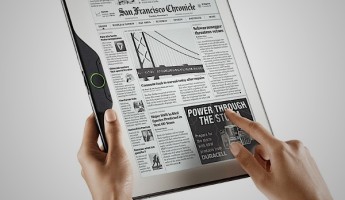
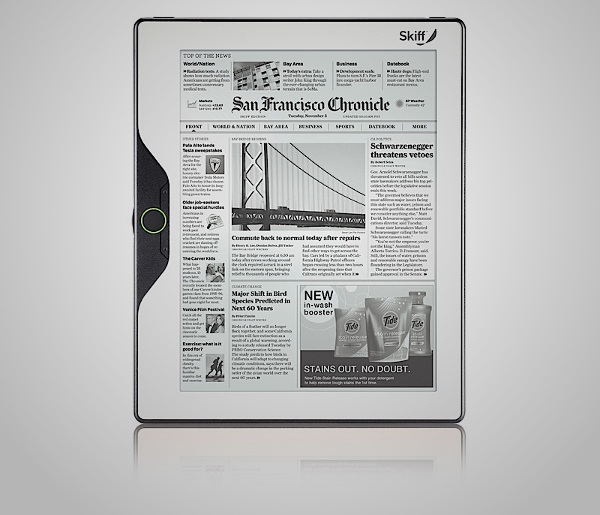
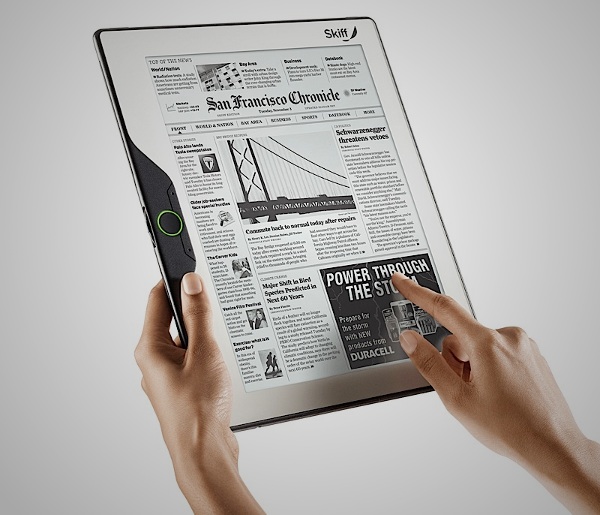
Skiff Reader: The Ultimate E-Reader | If you bought an Amazon Kindle DX in 2009, prepare for a heavy dose of buyer’s remorse. The Skiff Reader has overtaken the Amazon Kindle DX as the largest e-reader on the market, but its size isn’t what makes the Skiff so special. The Skiff Reader brings two new technologies to the large-scale e-reader market: a touchscreen e-ink display and “silicon thin-film-transistors on a flexible steel substrate”.
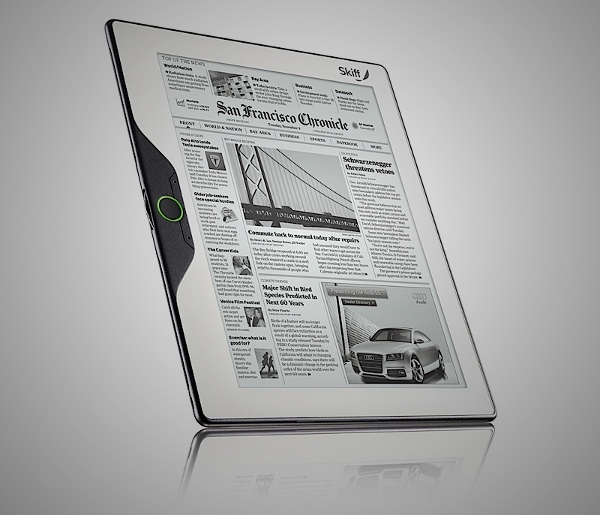
The Skiff Reader pushes the e-reader standard by featuring a full touchscreen display spanning 11.5-inches. The Amazon Kindle DX and smaller Kindle models don’t feature touchscreen e-ink, neither does that Barnes and Noble Nook (while the latter has an LCD touchscreen below the e-ink portion). This provides a new, finger-friendly world of navigation as you flip pages, highlight and select content modules and skim through your favorite ebooks.
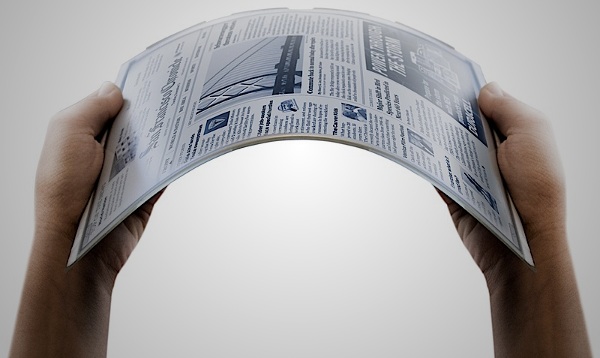
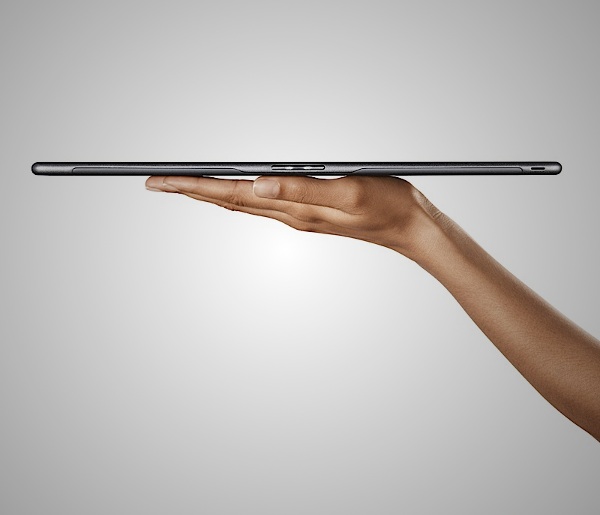
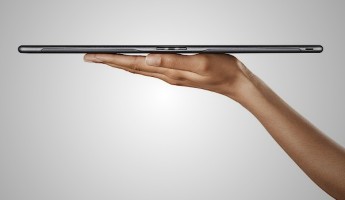
The “silicon thin-film-transistors” technology is a bit more esoteric. In short, the technology used in the Skiff Reader makes it flexible– meaning it can bend and warp on a whim, giving it a more durable and rugged build in contrast to those crackable Kindles. The Skiff uses a metal foil design that merges with the thin film transistors to fit into a low-profile shape, in this case just a quarter-inch in thickness.
The Skiff reader is coming later this year, available at Sprint retail outlets and using the Sprint 3G network. While it’ll be some time until Skiff hits the streets, we can already hear the nervous hustle of the e-reader market trying its hardest to catch up.


Sexy piece of hardware but what content will it have access too? Amazon already has their Kindle and I bet they’re going to be slow to consider dropping their own device for one manufactured outside of their influence. When I chose my Kindle I already knew the Sony e-Reader was nicer, but the Kindle had much more content available. I still don’t believe Sony’s caught up with Amazon’s large catalog.
Hi Kamala!
The Skiff Reader is a product of Hearst Corporation, a media conglomerate which owns a pretty staggering number of newspaper companies, magazines, television products and otherwise. Here’s a glimpse at their own portfolio:
http://en.wikipedia.org/wiki/Hearst_Corporation#Assets
I doubt they’d launch a product like this without plentiful content deals with book distributors and otherwise that could rival Amazon and Barnes and Noble– at least in terms of top-level titles (but couldn’t compete with Amazon’s long tail product catalog).
You fail to mention that the Sony Reader has already come out with a touchscreen. This ISN”T the only touchscreen reader available on the market.
I don’t consider the Sony Readers part of the “large-scale e-reader market”– only the Skiff Reader and the Kindle DX. Since those are the only two full-size versions, the touchscreen is a point of differentiation between the Kindle DX and the Skiff Reader. The Kindle and Kindle 2, the Sony PRS-900BC and others are small, book-size. Hopefully that clarifies my justification, sorry if my writing was unclear.
What the hell is wrong with an old fashioned book?
@Michael,
Nothing, actually; books serve their intended purpose just fine. However, it would be difficult to read the Washington Post or Time on the subway with a hardbound copy of Hornby’s How to be Good, however satisfying it might be to hold the book and turn its pages.
Michael what is this book you speak of!!!
This looks like a very nicely designed piece of kit. There is nothing wrong with the old fashioned book for those who want to buy printed books. People have got to stop having these ‘luddite’ feelings about reading devices like these. It’s a choice whether you buy one of these. If you have a job which involves a lot of travel and you read a lot then this type of device makes sense to buy. If you don’t travel a lot, then don’t buy one and stick with your books.
I think that the Skiff device looks like a better experience than devices like the Sony Reader (which is quite disappointing).
One friend of mine would buy a device like this. He is an airline pilot who reads a lot. That’s a niche audience for a marketer to target. There are about 79,000 airline pilots in the US alone. Forget all the talk about ‘mass appeal’ for devices like this. That misunderstands how device manufacturers will be marketing electronic reading devices.
Well said Amoebic!
I’ve been holding back on getting an e-reader because innovation [and pure awesomeness] is rarely first out of the gate.
Do you include the iRex in your “large scale eReader Market”?
If not, how do you define “large scale”?
@miami, looks like the iRex is a pen-based device. So it’s not the same kind of “touch screen” we’re referring to here. It /is/ a touch screen, technically– just a different kind.
Ok, I am not an e-reader kinda guy my self but when I stumbled on this and read it I found myself getting pretty happy. I was thinking off all the things i could do with something like this. That was portable and had a touch screen but, had more of a computer functionality. I don’t think even touch screen laptops have become as thin as this. I would love to see something like this that is more of a computer instead of an e-reader.
Hey Rico,
Thanks for your comment! You may just get your wish for that smaller, thinner touchscreen computer. While there have been a few nice touchscreen tablets released in the last month, Apple is likely to announce their own tablet later this month. Expect no small news story out of that!
I haven’t entered the eReader market yet, but this has the coolness factor that could woo me away from my hardbacks, at least for newspapers, magazines and some books. I’ll never completely give up my leather bound first editions!
In one year I will buy both an e-book and a smart phone. I’m waiting for the Blio 3 (software), Skiff 4, Kindle 3M, Nook 9, Sony Reader 7 (wireless finally), Apple iSlate 3 or Google Beta Nexus 100. Or should I wait two years and …….?
All of these inventions use the same basic code and Next Big Thing
Technology we call WORDS. Language is the ultimate high technology. Is someone at Cambridge or MIT working on a word replacement? Is someone working on a way to put out fires electronically? I could go on because I have a brain and words. What good is a smart phone if you’re not smart. You can love tree books and e-books.
I think this year the main competition for market would be among Que, Skiff and Bebook 2 in the wave of newcomers. I include bebook 2 because it has it’s own dedicated djvu crew that won’t give up the file format in return of cooler features. But Endless Ideas are so sluggy that I am afraid they will loose it to the first two.
Anyway, for now, I stick to my TP2 phone and delight in the alliance of Mobi reader and MDict.
@nwyliejones: Language could also be thought of an excuse for our ignorance; to what degree? It varies from person to person..
@Shahir:
Your timing could not be better– the Plastic Logic QUE ProReader was just officially revealed at CES. It’s slightly smaller than the Skiff Reader, with a 10.7-inch touchscreen, but it adds some new functionality like a touch-based keyboard that allows its users to send email and notate content. Pretty cool. Not as sexy as the Skiff Reader, but just as technically impressive.
oops, there is a soft spot up there: *its :j
@thecoolist, Actually I wasn’t aware of the Skiff until this morning. I was checking for any news on Que since I knew it is going to be revealed today, that I heard in a (slightly dated) video of the Skiff reader and realized that it’s serious competitor. Unfortunately I couldn’t find any intel on the file format on their website. As for Que, although the outward appearance may not sound so cool but it appears to have some functional user friendly interface. Anyway, I could never make my mind between the luxury of capacitive touch screens and the precision of resistive brands.
The price list for QUE is wee bit off sanity though:
Plastic Logic will have two models. One that will cost $649, has 4GB of space and wireless capabilities. An 8GB model that will have wireless and access to AT&T’s 3G network will cost $799. Those wireless and cellular connections will let users purchase books and periodicals from Barnes & Noble electronic collection. Users also can upload documents in several formats including PDFs and Microsoft Word Excel formats.
[Source: http://www.freep.com/article/20100107/BLOG36/100107029/1006/NEWS04/Versatile-e-reader-Que-debuts-at-CES
So…I am gonna wait and see what’s up with Skiff and Bebook 2 :j
There’s a lot that I like about this but it’s too big. I would rather have something that is about the size of a paperback book. Also, 1) I predict that it will cost way, way, way too much just like every other e-book reader I’ve seen so far and 2) proprietary formats are evil. All e-books should use the same format (PDF or .txt) and all books, magazines and newspapers should be available in these formats.
Oops… I see now that someone has already posted the price. I was right – way, way, way too expensive.
Without actually holding/touching any of them, the Skiff Reader seems the most popular. But that’s one of the problems, popularity. Will any/all e-readers adopt .pdf as their uniform format? Will any/all e-readers open their content base to all languages/graphics? And, finally, will any/all e-readers support text-book formats with heavy amounts of graphics/scientific equations/diacritics?
From a potential consumer:
First demographics:
Both my wife and I are over 65, still employed, each earn more than 100k a year.
We like books but we are planning to buy an e-read in the first quarter of this year. If you aren’t on the shelves early then you are behind the power curve.
Our price point: anything over 400 is a non-starter.
Need to be able to handle and operate it before buying. I’ve used a kindle and I’m interested in the DX but unless I can test run it I’m not buying it. Barnes and Noble and Borders have an edge here.
Content: We will select on which product offers us what we want. Newspapers: Washington Post, NY Times, WSJ, Financial Times, International Times, Guardian.
Magazines: Foreign Policy, Scientific American, New Republic, Aviation Week, ENR, etc.
Books: fiction, non-fiction and technical (I’m a construction manager and being able to take along my technical references in a compact form would be neat.
pdf capability: we are still working and being able to condense a brief case of files and folders into electons (bits and bytes) would be cool.
color: I’m indifferent to and if that capability drives the price above 400 I’m not interested.
steaming video: not important I have a laptop and the desktop that I built plus a HDTV.
e-mail: maybe but I refuse to pay the wireless charges for that capability on my cell phone and besides the electronic leash is long enough already. Airports have free wireless.
global reach: yes
So that is what I’m shopping for. From my experience with the Sony e-reader at borders it is a non-starter.
Kindle
eDGE
Que
skiff
alex
are interesting but only if they are available by mid-march
Ray S Leonard, PE
I am waiting for the price on these to go down, and I am waiting for better attention to material availability and more common sense copyright rules. I mean, a lot of these companies only allow stuff from their stores, or DRM material, or etc etc, stuff that’s all restricted. What if I want to plug in a flashdrive and read my own pdf? I’ve yet to hear any device with ease of doing so. If they do, let me know.
The skiff looks the goods. I would suggest they market a large screen and small screen version. I think there’s room in the market for both. I hope the entire industry sorts out content and proprietary rights issues soon – there is too much uncertainty at the moment.
And Ray ^^^, you and the missus both earning over $100k p.a. and you’d baulk at a price tag over $400?
You’re not serious, are you?
Some years ago I bought the Bebook which was quite ahead of its time. Content was not so good, so I had to download some stuff to get it up and going. It was also full of bugs.
The worst thing was that the display was too fragile! I managet to crack it!
So this new reader looks kind of promizing
To those who ask “what’s wrong with a good old fashioned book?” I have a 1,000-2,000 physical book collection… Yeah, SPACE is what’s wrong with a good old fashioned book. Plain and simple, this eliminates the need for me to use book cases and floorspace that can be better suited for family use.
The days are coming when nobody would need a book, let alone an e-reader. Ever thought of brain implants where data is broadcast right into your head. No need for eyes as the medium of transfer. No need for hands and fingers to hold and flip anything. No need for earphones to listen to music or any audio data. Hell, we’d be walking receivers.
This thing looks perfect for MY primary reading application. I have a broken tailbone, and am an avid reader of both books and the newspaper. My “comfortable chair” for reading is the toilet!
Everything I have read about the Skiff appears to make it the perfect ereader except for one thing. Nobody is talking about pdf support for the Skiff. If it doesn’t have that, and I can’t imagine they would actually leave that out on any ereader; this thing is going to bomb. So why doesn’t the Skiff.com website talk about pdf support?
The Skiff looks to be shaping up as an excellent product. My only concern is that I have a collection of over 3000 .lit format ebooks. That is the main selling point for me. If it reads .lit I’m there.
Definitely want to hear what the verdict is on the Skiff. Will it provide pdf reading capability. I’ve been leaning over to buy the Sony Reader only because my library has a huge selection of books I can download for free. I would like to see what the Skiff has to offer.
Let me know when they make these things waterproof.
I’d love an e-reader I could take to the bathtub or the beach, but until then, I am not interested.
Oh, by the way I didn’t see any Canadian Content IE newspapers, They would be missing a big market cup on readers.
Am I the only person that reads in bed? Why must I stick with my Nokia 770 that is backlit? I’d love to upgrade, but the best feature of my Nokia doesn’t exist on these shiny new things.
I keep hoping, although, I must say, I’ve been using it for almost 5 years and love it. (Never had to replace the battery either)
Does anyone know when the skiff is scheduled to debut and be available for sale?
The Skiff reader looks fantastic. I own the iRex DR1000 and would move over to this reader if I have available to me many magazines and Newspapers to choose from.
What gives me pause is what no one is talking about and in the end will kill all of the readers. It is DRM or Digital Rights Management for those that don’t know the acronym. Amazon refuses to allow Mobipocket users the ability to purchase Kindle books even though it is essentially the same format. Amazon owns Mobipocket. So even if I wanted to move over to a Kindle I can not without losing my library. Amazon also does not allow Mobipocket to reside on readers that use other DRM formats. This means epub readers can’t host Mobipocket. I have also lost books when I moved to a new reader and could not download previous purchased set of books because the publisher got into a tiff with Fictionwise.
Skiff with the backing of Hearst should work to break down these walls. Is this an ebub or mobipocket reader? Why can’t we have both? Can we be assured that Skiff won’t change DRM formats years down the road after accumulating an expensive library.
The laws allow the consumer fair use of our digital content but the publishers are not forced to offer easy access to fair use of our purchases. When the public discovers the library they own is not really lifelong then this product niche will start to falter.
Please, please Skiff, Hearst and others do not be silent about DRM. Make a stand and fix this problem. Force Amazon to remove the exclusive contracts for Mobipocket.
In regards to a previous question on when it will be available.
I first heard of the Skiff reader in 2009 and I contacted the company since I was very interested since I have to deal with a lot of technical reference documentation. I was then told that they had prototypes and was “just” going to finalize there business model, setup the production lines and that’s it.
Again some month ago I tried to contact them but received no answer this time.
From what I can gather from there (static) web page is that there are no detailed spec nor any more (even guarters or even half years) indication on when a product can be launched.
The site focuses on the publishing model (there business model) and very little (if any) real information about the reader is available.
This typically means one of two things:
1) They are facing sever technical issues and have promised more than they can keep (which I personally believe to be the case) and they simple cannot even give an indication on when it will be ready.
2) They have indeed made the “deal-of-the-century” with some publisher which will help push 100,000 s of these devices but are forcing the people behind Skiff to shut up until everything is ready (the Apple way)
From the very initial information on the Skiff reader the specs and the information seemed almost to good to be true which usually means it was
So, for those of you who are waiting. Don’t hold your breath, you might become a tad blue in the face before this device sees the light of day.
Hopefully I’m proven wrong, because I would really love this device, but sadly I don’t believe so.
kindle DX’s cons : no wifi, no touchscreen
ipad’s cons : no e-ink
que plastic logic’s cons : price
i would love the skiff with these features
1) it has native PDF support
2) built-in web browser to browse news site for free(eg bbcnews/cnn)
3) replaceable battery
4) japanese quality control
5) support for microSD card
6) under $550
NewsCorp has bought Skiff – that makes it very interesting. When oh when will they release it????