You walk into your bedroom at the end of a long day and something just isn’t right.
The paint’s fine. The art’s up. The dresser matches the bed frame. On paper, nothing’s wrong. But the second you sit on the edge of the bed, your shoulders don’t drop like they used to. The room feels flat. Kind of tired. Like a hotel you wouldn’t book twice.
So you start running the usual list in your head. Maybe I’ll repaint. Maybe the curtains are off. Maybe I should hang a bigger piece on that wall. You pull up a shopping cart. You tell yourself the room needs a refresh, and a refresh means buying things.
Turns out, three interior designers were recently asked where a bedroom actually goes wrong, and all three of them pointed at the same thing. It wasn’t the walls. It wasn’t the art. It wasn’t the curtains. And one half of the fix won’t cost you a dime.
The mistake almost everyone makes
Most people treat a bedroom like a gallery. When it feels off, we try to fix it with the decor. A new throw. A new print. A fresh coat of paint on one wall. We figure the problem is how the room looks, so the fix must be something to buy or hang.
That’s why so many refreshes don’t really land. You spend a weekend and some money, and a week later the room still feels off. The real problem never got touched.
When The Spruce asked three designers, Alina Mehrle of Asthetique, Jasmine Artis of J’Miracle Designs, and Barrett Oswald of Barrett Oswald Designs, what they’d fix first in a bedroom that feels off, none of them talked about paint or prints. They all pointed at something more basic.
The matching-set trap
Before we get to the fix, it helps to understand why so many bedrooms feel flat even when nothing’s really wrong with them.
Mehrle says it plain: “Everything the same height and from the same set feels like a hotel room, not a sanctuary.”
That one line explains a lot. When you buy a bedroom in a box, the matching headboard, nightstands, dresser, and mirror all from one set, the room ends up perfectly matched and totally lifeless. Same wood, same height, same finish. Your eye has nowhere to land. It looks like a showroom instead of a place you live.
Her advice? The opposite of what the furniture store sold you. “Mix periods, textures, and scales fearlessly,” she says. One tall piece next to a short one. A warm wood against a cool metal. An old lamp on a modern table.
The lighting’s working against you too
Most houses come with one small ceiling light and maybe matching lamps on the nightstands. That’s a room lit for a hallway, not for sleep.
Mehrle says to layer light at different heights. “Light should feel like jewelry in the room,” she says. Put the ceiling light on a dimmer, add a lamp or small wall light at a different height from your nightstand lamp, and skip the harsh white bulbs. The warmer, lower, mixed glow does more for how a bedroom feels than most things you can buy.
So what did the designers actually agree to change first?
Ready? When all three were asked what to fix first, they pointed at the same two things.
Your bedding, and where your bed is sitting.
That’s it. Not the walls. Not the art. The sheets you’ve been sleeping on, and the spot you shoved the bed into when you first moved in.
Start with the bedding. Go for fresh sheets with a bit of contrast and some texture you actually want to touch. Soft, natural fabrics like cotton or linen. Not another white-on-white set. If your current bedding has gone thin, pilly, or dingy, that alone is dragging the whole room down, because your bed takes up more space than anything else you own.
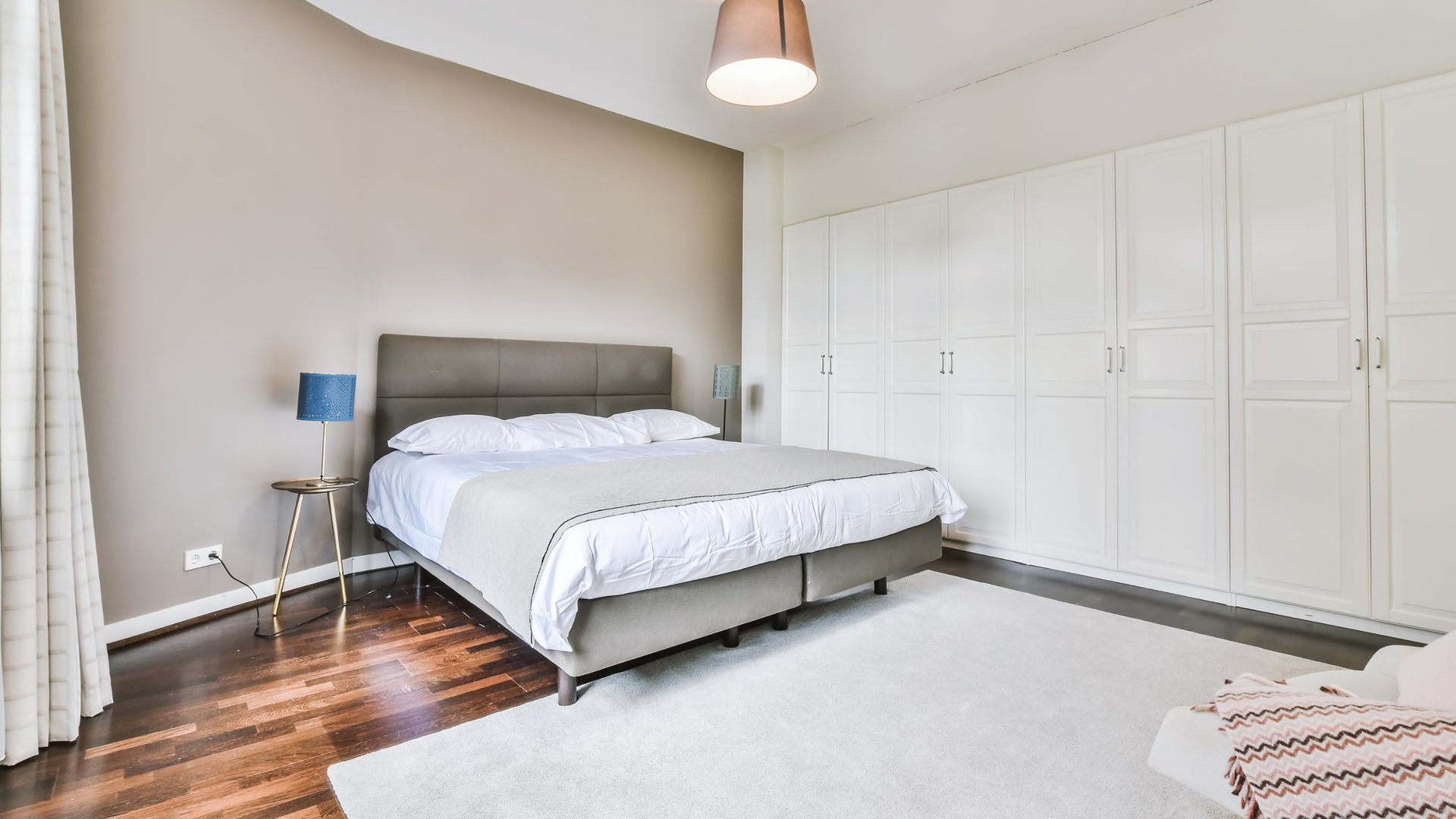
Then look at where your bed is. Mehrle is sharp about this one: “Your bed is the altar of the space; it deserves prominence. Center it on the most commanding wall, ideally with architectural symmetry. Flank it with substantial nightstands.”
Plainly: your bed should be the main thing you see when you walk in, centered on the longest or most important wall, with a real nightstand on each side instead of one nightstand and a pile of books. A bed shoved in a corner, or on the wrong wall, throws the whole room off. Moving it to the right wall costs nothing. Not a cent (or a euro). It’s the biggest single change on this whole list.
The other things worth fixing, in order
Once the bed’s sorted, the rest falls into place.
Hang bigger art. “Artwork that’s too small often reads as an afterthought,” says Oswald. Go a size bigger than feels right. A piece around 36 inches (about 90 cm) wide beats a 20-inch (50 cm) one over a bed.
Pick one color and stick with it. Artis says to start with one main color and layer softer versions in different fabrics. Calm but not boring.
Clear the clutter. A bench with storage, or baskets, and a set spot for the stuff that ends up on the floor.
Don’t forget the ceiling. “Beige carpet and white ceilings are missed opportunities,” Mehrle says. She calls the ceiling the “fifth wall” and says paint or wallpaper up there can change a room nobody ever looks up at.
The thread through all of it: your bedroom isn’t a gallery. It’s the one room where you’re most relaxed, and the fix almost always starts with the bed.