

The dresser has been in the corner of the bedroom for years. The wood looks dark. One drawer sticks. There’s a water ring on top that nobody remembers putting there.
So you grab a can of chalk paint. Everybody paints their old dressers. That’s what you’re supposed to do, right?
Here’s the uncomfortable part. The interior designers getting paid real money to style people’s homes right now walk into rooms like yours every week and quietly leave the paint can on the shelf. They aren’t sanding it. They aren’t refinishing it. They aren’t distressing it to look rustic. They’re not even considering it.
These are people who grew up around antiques, trained in design history, and spend their days inside expensive homes. Their instinct about that paint can is in the opposite direction of yours.
They’re doing something else, and that something else is the exact reason the old dresser suddenly looks like it belongs in a magazine shoot instead of a thrift store corner.
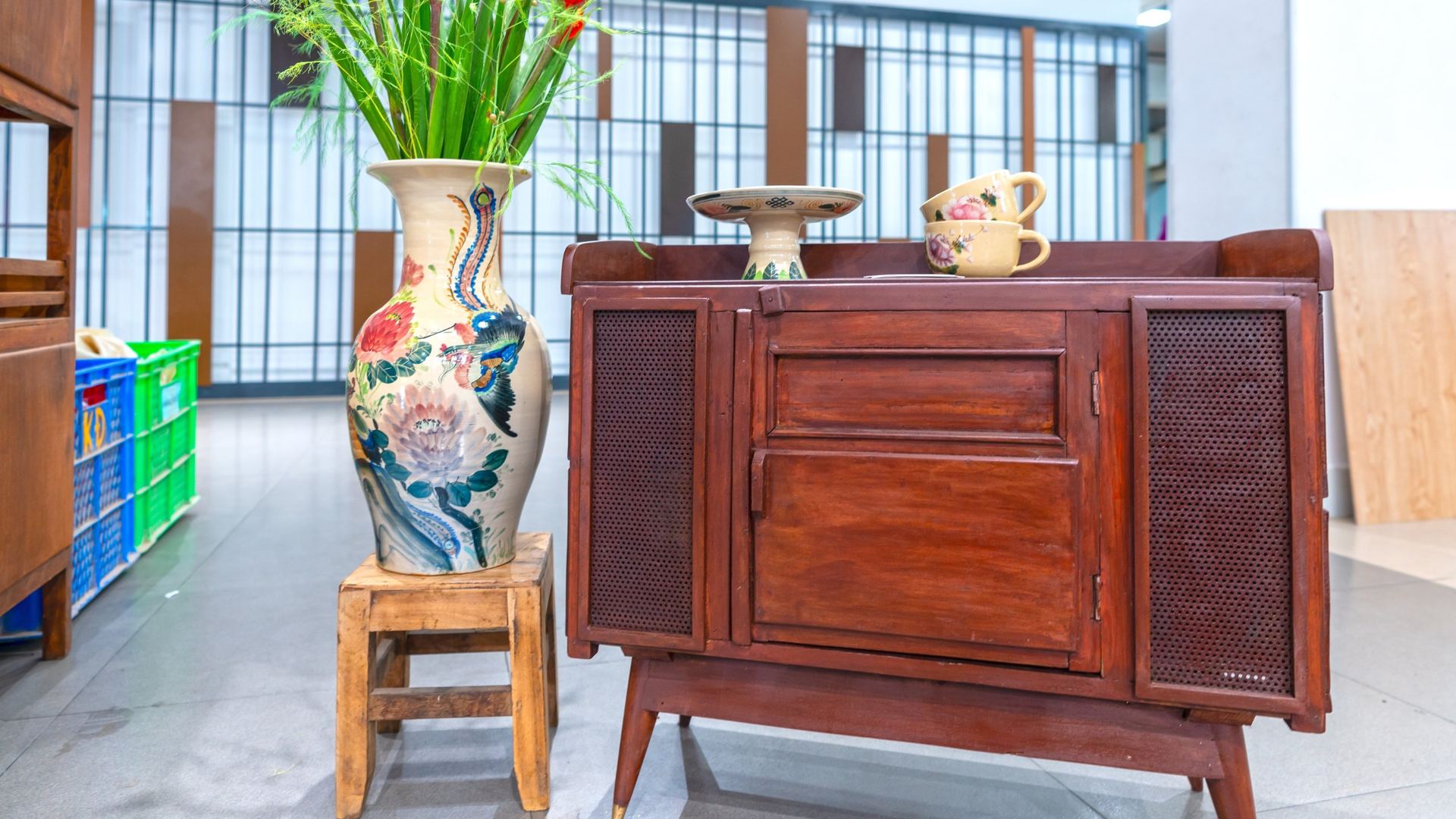
It also costs almost nothing. Most of the time it uses stuff you already own.
Before we get to the move, it helps to understand why they’re treating that paint can like a loaded weapon. Because once you see that, the rest of the story makes a lot more sense.
The paint is erasing the one thing you want
Good Housekeeping surveyed more than 15 interior designers for its 2026 trend report, and the look all of them pointed at has a name: refined layering. It was named by Kerrie Kelly, a designer based in Sacramento whose work the magazine picked as a defining style for the year.
In plain words: old things look better next to new things, and new things look better next to old things. That’s the whole trick.
But the part that matters for your old dresser is this. The wear is what makes it valuable. The scratches. The softened edges. The brass pull with age marks from forty years of being touched. Designers have a word for it: patina. They treat it the way jewelers treat the inside of an old gold ring. You don’t polish it off.
The second you paint over those age marks, the piece stops saying “this has lived in real homes before” and starts saying “someone had a Saturday afternoon and some paint.”
And the paint itself doesn’t age well. Chalk paint chips at the edges within a year or two. The primer shows through where the drawers get used the most. Once it’s on, you can’t just wipe it off. Stripping and sanding to undo the paint also sands off the age marks you’d now be trying to save. The piece gets locked in. It only looks older and sadder from there.
Jeremiah Brent, the interior designer and home expert on Queer Eye, told Good Housekeeping: “new pieces actually look better when they’re next to something old.” The old piece is the reason the room feels like a home instead of a store display.
Leanne Ford, another designer the magazine spoke to, said that when every single item in a room is brand new, people can’t name what’s missing, but they feel it. No history. No warmth. No sense of time.
So the paint has to come off the table. Fine.
But if you put the brush down and walk away, the dresser is still going to look tired tomorrow morning. Nothing’s changed. The wood is still dark. The drawer still sticks. The water ring is still there.
Something else in that room is quietly working against the dresser. And until you see what it is, no amount of paint, polish, or new hardware is going to lift the piece.
The real reason the room has looked tired this whole time
The dresser isn’t the problem. The problem is what you’ve been putting around it.
Walk back into the bedroom. The lamp on top is probably from the same era as the dresser. Framed photos in frames that match. A mirror above it in the same wood tone. A chair in the corner with a cushion that matches the mirror.
Every one of those things is old. Every one is from the same era. All of them are pointing at the dresser and whispering “this room hasn’t been updated in a long time.”
That’s the real reason the room feels tired. Not the dresser. The matching.
Cathryn Erickson of Cathryn Lindsey Design told Good Housekeeping that what makes a room feel personal is the gap between old and new. Designers don’t see a room that needs paint. They see a room that needs contrast.
What designers are actually doing instead
Four small changes. None involve a paintbrush. None cost more than a lamp.
1. One main piece. Opposite style around it.
Brad Thornton of Thornton Projects told Good Housekeeping to pick the room’s main piece first, then layer the opposite style around it. If the dresser is the main piece, everything above and on top of it should be modern: a sleek matte-black ceramic lamp instead of an old brass one, one simple abstract picture instead of an oil painting of a horse.
Old dresser plus old lamp plus old mirror reads as “never updated.” Old dresser plus sleek modern lamp plus simple abstract picture reads as “a designer did this.”
2. Put something glossy next to something natural.
Erickson’s other rule: if the room already has wood, stone, or leather, add glass or chrome. Old oak table plus one clear glass bowl. Old leather chair plus a chrome side table. The eye reads that texture gap as done on purpose.
3. Follow the 3-2-1 rule.
Kelly’s math from Good Housekeeping: “three textures, two finishes, one statement color.” Wood, linen, brass. Matte black and aged brass, not every metal in the room. One deep green cushion, repeated once.
4. Clear the space around the piece.
Brent says each piece needs room to be seen. Neutral wall. Clean top. One lamp. One object. One picture. That’s it.
Two more fixes you can undo in a minute
- Swap the hardware. Amy Youngblood told Homes & Gardens the fastest change on an old dresser is better quality pulls. Brushed brass or matte black transforms a drawer front without touching the wood.
- Add one good textured cushion. Nick Cryer of Berkeley Place told Homes & Gardens that one cushion with real texture does more than three cheap ones.
The paint can isn’t undoable. These are.
The quiet point
The dresser hasn’t looked tired for ten years because it needs paint. It’s looked tired because nothing around it has been treating it like the asset it is. Let the age do its job. Give it something modern to stand next to.
That dresser becomes the most expensive-looking thing you own.
Sources: (1) The Verdict Is In: Refined Layering Will Be Everywhere in 2026 (Good Housekeeping); (2) Designers Say You Might Be Mixing Vintage and Modern Decor the Wrong Way (Good Housekeeping); (3) 5 easy ways to make furniture look more expensive according to interior designers (Homes & Gardens).