The estimate came in at up to $200,000. Crystal Drinkwalter and Jazmyn Canning had pictured a natural swimming pond on their Canadian property, and that price stood squarely in the way. So they took the harder route: a professional design, months of hands-on work and an extraordinary amount of stone to move.
The quote that changed the plan
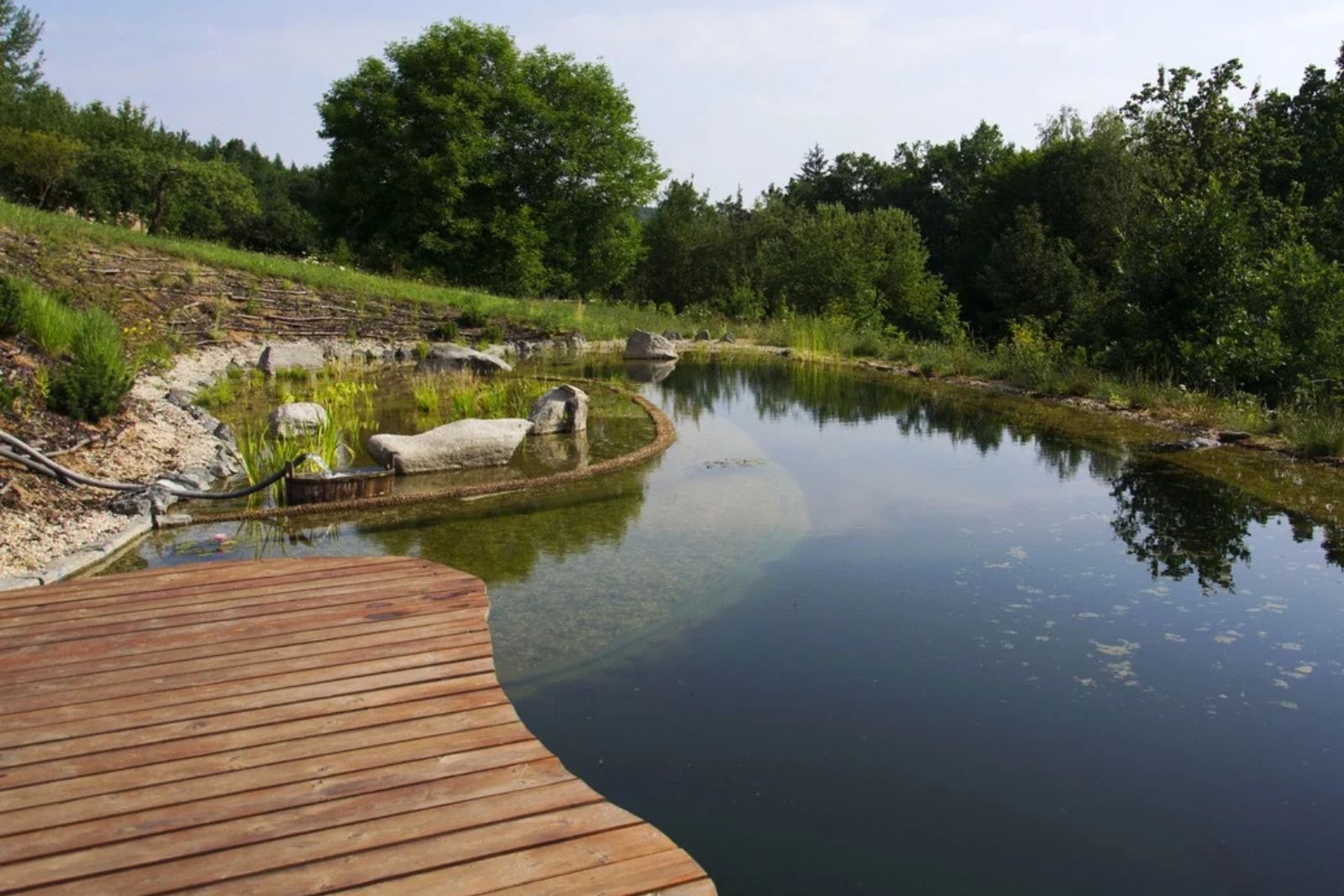
Crystal Drinkwalter and Jazmyn Canning wanted a swimming pond that felt like part of their 65-acre property in Canada. They imagined large boulders, aquatic plants and a natural-looking place to swim without the routine chlorine treatments associated with conventional pools.
Then came the estimated cost. According to an October 2026 interview with People, a professionally built pond of this kind could cost as much as $200,000, depending on its design and site conditions.
Rather than abandon the project, the couple decided to take on much of the construction themselves.
They didn’t simply rent an excavator and start digging. They worked with Derek, an experienced professional at the Ontario landscaping company Quiet Nature, to develop the plans before beginning construction.
Drinkwalter and Canning then supplied much of the labor. The project took more than two months, and they reported spending approximately US$52,000.
Compared with the upper estimate of $200,000, that represents a difference of $148,000. It is a comparison between a professional construction estimate and their reported project spending, not a verified calculation of net savings or the value of their own labor.
Reaching that figure still required a remarkable amount of physical work.
100,000 pounds of boulders, one by one
With the plans ready, the couple excavated the pond and shaped the swimming area alongside a planted filtration zone.
They installed the necessary pond components and began arranging the enormous rocks that would give the finished basin its natural appearance.
Altogether, the project involved approximately 100,000 pounds of boulders. The heaviest weighed around 7,500 pounds.
Each large rock had to be individually secured, lifted with machinery and carefully positioned. The placement mattered for both the appearance of the pond and the stability of its edges.
Then rain turned the construction site into mud.
Before filling the basin, the couple had to clean the rocks and remove clay and sediment that had accumulated during construction. It was slow work, but it helped reduce the amount of loose material entering the water.
Finally, eight water-truck deliveries brought approximately 120,000 liters of water to the property, at a reported cost of around $2,000.
The finished pond has an avocado-like outline and measures approximately 50 by 35 feet.
Large rocks create places to sit and enter the water, while aquatic plants soften the edges and help the basin blend into the surrounding landscape.
For anyone drawn to that natural appearance, TheCoolist’s collection of garden water features offers additional examples of how stone, planting and moving water can work together.
But the visual simplicity of the finished pond conceals a more complicated system beneath the surface.
Natural doesn’t mean hands-off
A natural swimming pond isn’t simply an excavated hole filled with water. Keeping it suitable for swimming requires careful design, circulation, filtration and ongoing maintenance.
Drinkwalter and Canning’s pond includes skimmers, two pool-style pumps, filtration equipment, aeration, a planted wetland area and ultraviolet treatment.
Skimmers help remove floating leaves and debris. Pumps circulate water through the filtration system, while the planted area provides surfaces for beneficial microorganisms and supports nutrient uptake by aquatic plants.
Aeration helps maintain oxygen levels, and ultraviolet treatment provides an additional means of managing microorganisms passing through the equipment.
These components have different functions, and their effectiveness depends on the design, flow rates, maintenance and operating conditions of the pond.
Importantly, natural filtration and UV treatment do not automatically guarantee that swimming water is free from harmful microorganisms.
Unlike a conventional disinfected pool, a natural swimming pond may not maintain a continuous chemical disinfectant residual. Water quality therefore requires appropriate monitoring and a management plan suited to the installation.
The couple’s routine includes emptying skimmer baskets, vacuuming leaves and sediment, and cleaning or backwashing filters as required.
Aquatic plants contribute to the system, but they cannot replace mechanical maintenance or water-quality checks.
The result may look like a small lake, yet it still operates as a carefully managed swimming environment.
Where the shovel hands off to a pro
The couple’s project shows how much hands-on construction can reduce a professional quote, but a natural swimming pond isn’t a beginner excavation project.
Before digging, check local permits, zoning requirements, drainage restrictions and buried utility locations.
In the United States, the 811 service helps property owners request utility marking before excavation. In Canada, use the appropriate provincial One Call service and follow local excavation requirements.
Excavation design, pond liners, structural stability, electrical systems and the placement of extremely heavy rocks all require suitable professional expertise.
Water safety matters just as much as construction quality.
The U.S. Consumer Product Safety Commission’s pool barrier guidelines recommend a four-sided barrier at least four feet high, with self-closing, self-latching gates. These are U.S. safety recommendations, not a substitute for the applicable Canadian provincial and municipal requirements.
Natural ponds also present drowning hazards, potentially slippery or unstable edges, electrical risks and possible water-quality concerns.
Jumping rocks and other features should be assessed for safe water depth, clearance and structural stability rather than treated as decorative additions alone.
Drinkwalter and Canning completed their pond in time to enjoy it in August 2026. Their reported spending was far below the upper professional estimate, but the achievement depended on professional planning, specialized equipment and months of demanding work.
The lesson isn’t that anyone can build a swimming pond for $52,000. It’s that carefully planned owner involvement can change the economics of an ambitious landscape project, provided safety and technical requirements remain central to the design.