
The homeowner was ready to rip out her floor. She hated the travertine. She hated the little dark diamonds set into it. She was pretty sure the floor was the reason her powder room had never felt finished.
Then the designer walked in and told her the floor was fine. The walls were lying about it.
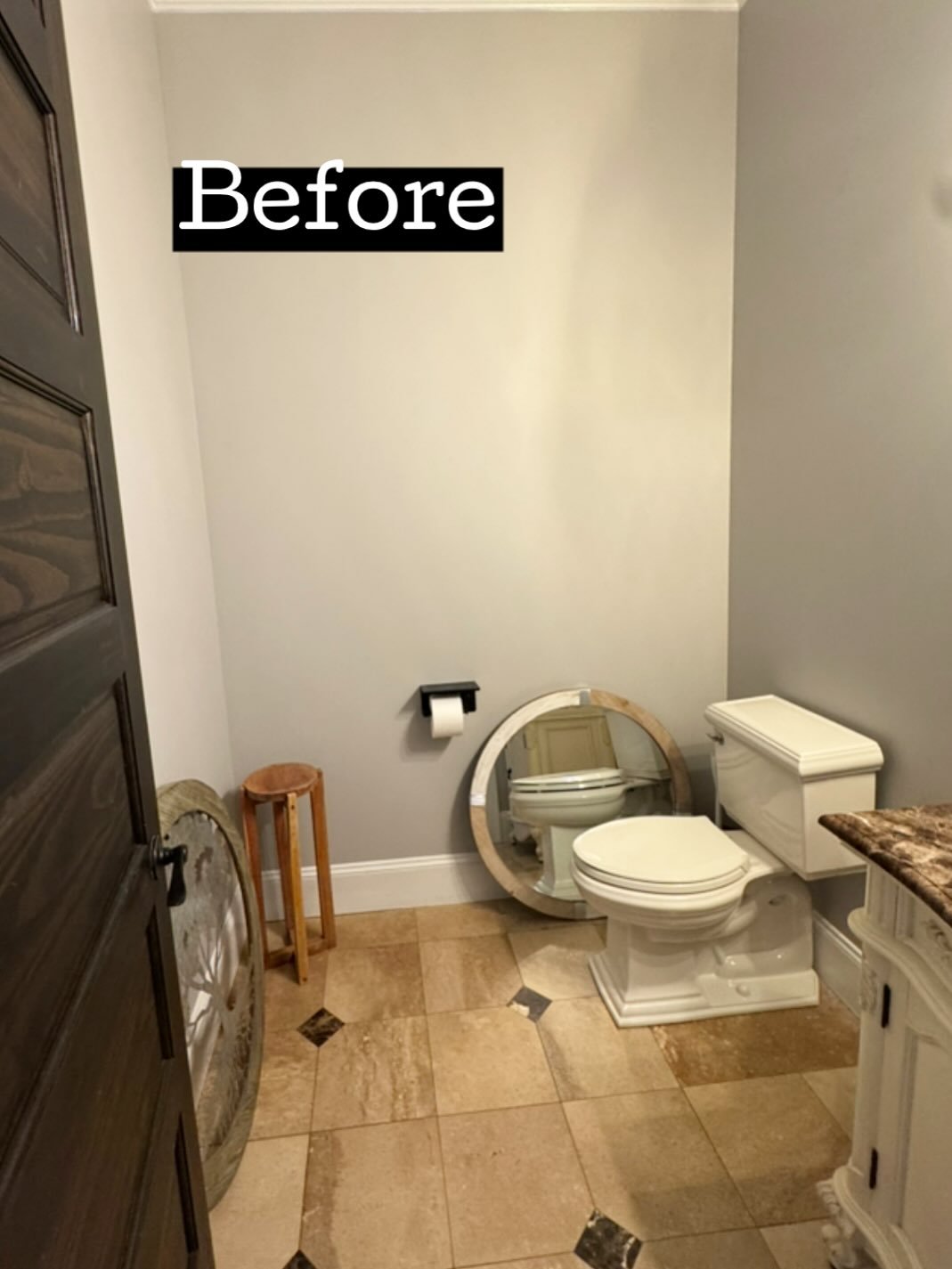
Picture a long gray box with a toilet on one end and a tiny carved vanity on the other. Greige walls. White trim. No mirror hung up yet, just a round one leaning against the baseboard, waiting for someone to decide where it belonged.
Everything in there was pretty on its own. None of it talked to anything else. The vanity was fussy, the mirror was ornate, the floor was warm, the walls were cool, and the whole room added up to a shrug.
Why the floor took the blame
Travertine with dark marble diamonds was a status floor fifteen years ago. In an empty room with cool gray walls above it, that same floor reads as dated the second you walk in. It’s warm. It’s busy. It has character. And when nothing else in the room shows up with any of that, the floor ends up carrying the whole thing by itself. That’s when it stops looking like a feature and starts looking like the problem.
The designer, Callie Shaw of Tin Lily Design, saw it right away: the floor didn’t need to go. It needed backup.
The vanity corner that proves the point
The vanity side told the same quiet, defeated story. A pretty carved base, a rich brown marble top, a three-bulb light overhead, and a huge stretch of flat gray wall where a mirror should have been. The vanity looked like someone’s grandmother’s piece dropped into a builder-grade hallway.
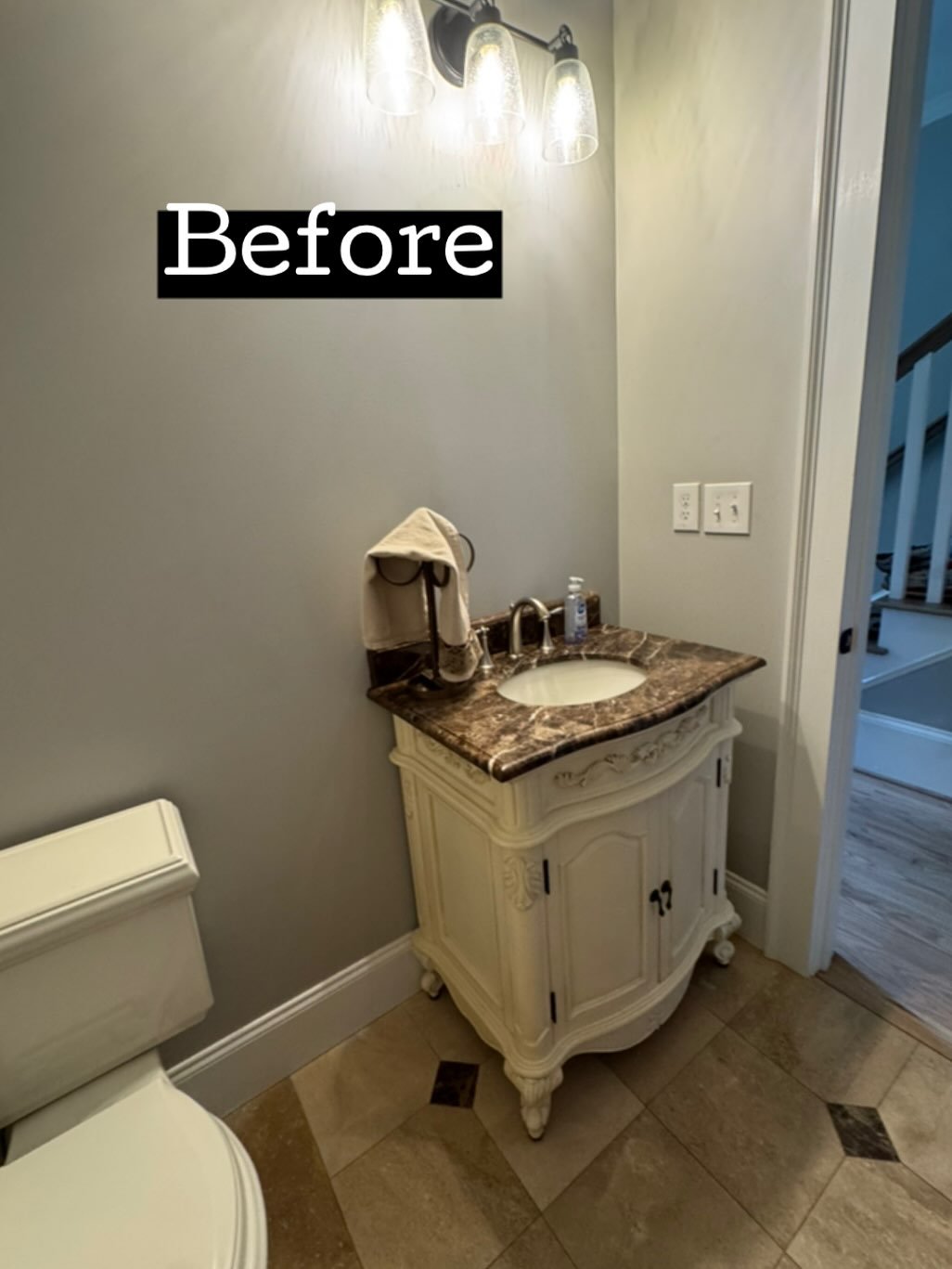
A plain wall wasn’t restful behind that vanity. It was awkward. The ornament had nothing to talk to.
The move most people would never make in a tiny room
Every design rule you’ve heard for a small bathroom says the same two words: keep it simple. Soft paint. Small mirror. Nothing busy. Let the little room breathe.
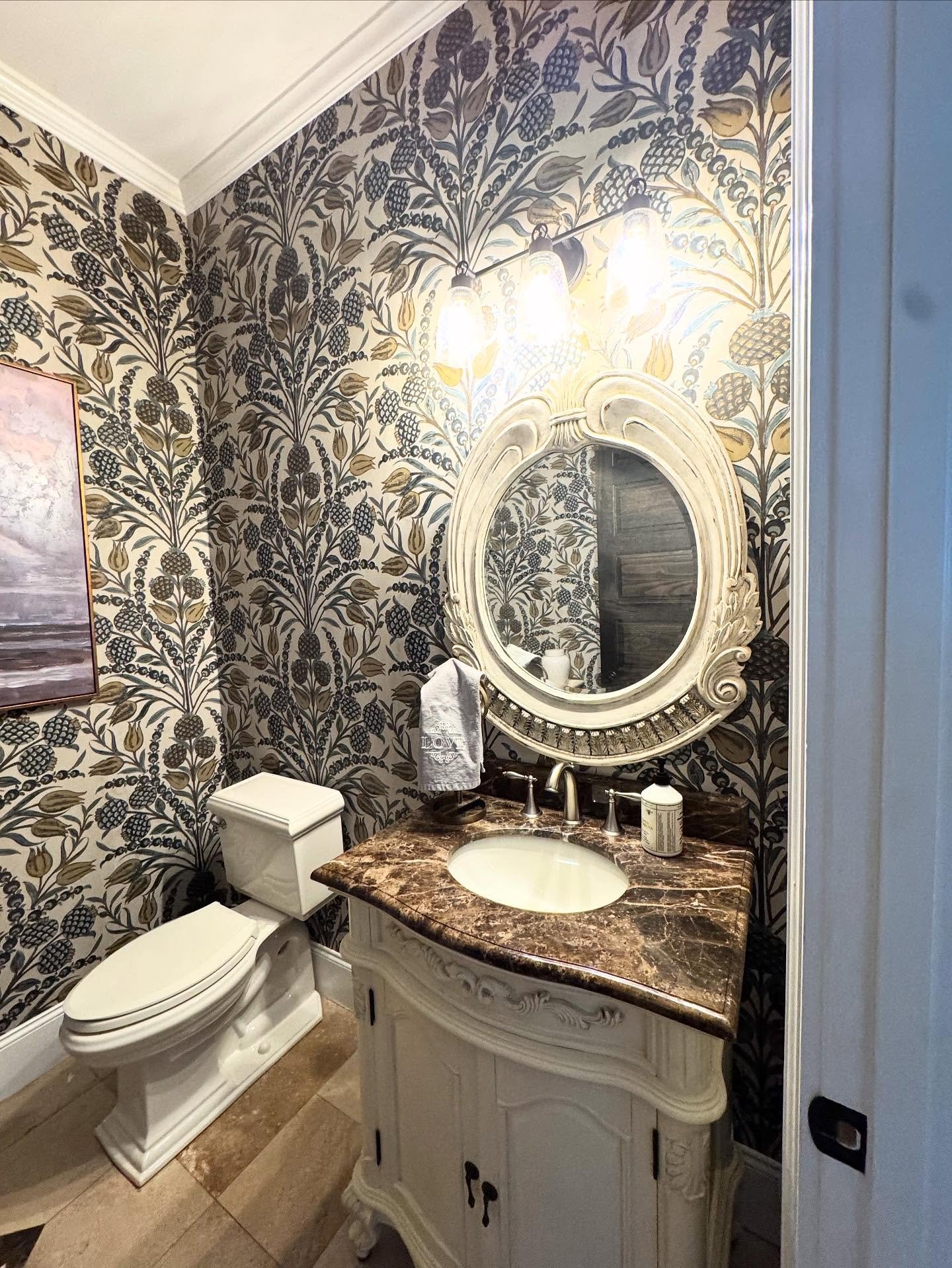
Callie did the opposite. She pulled out a Thibaut wallpaper covered in dense pineapples, long tulips, and climbing vines in moody charcoal, slate blue, mustard, and olive. Not a subtle pattern. Not a quiet color. The kind of paper most people would be afraid to use in a room ten times this size.
In a powder room this small, it should have been too much. It was the thing that fixed everything.
The second the walls went up, the floor changed jobs
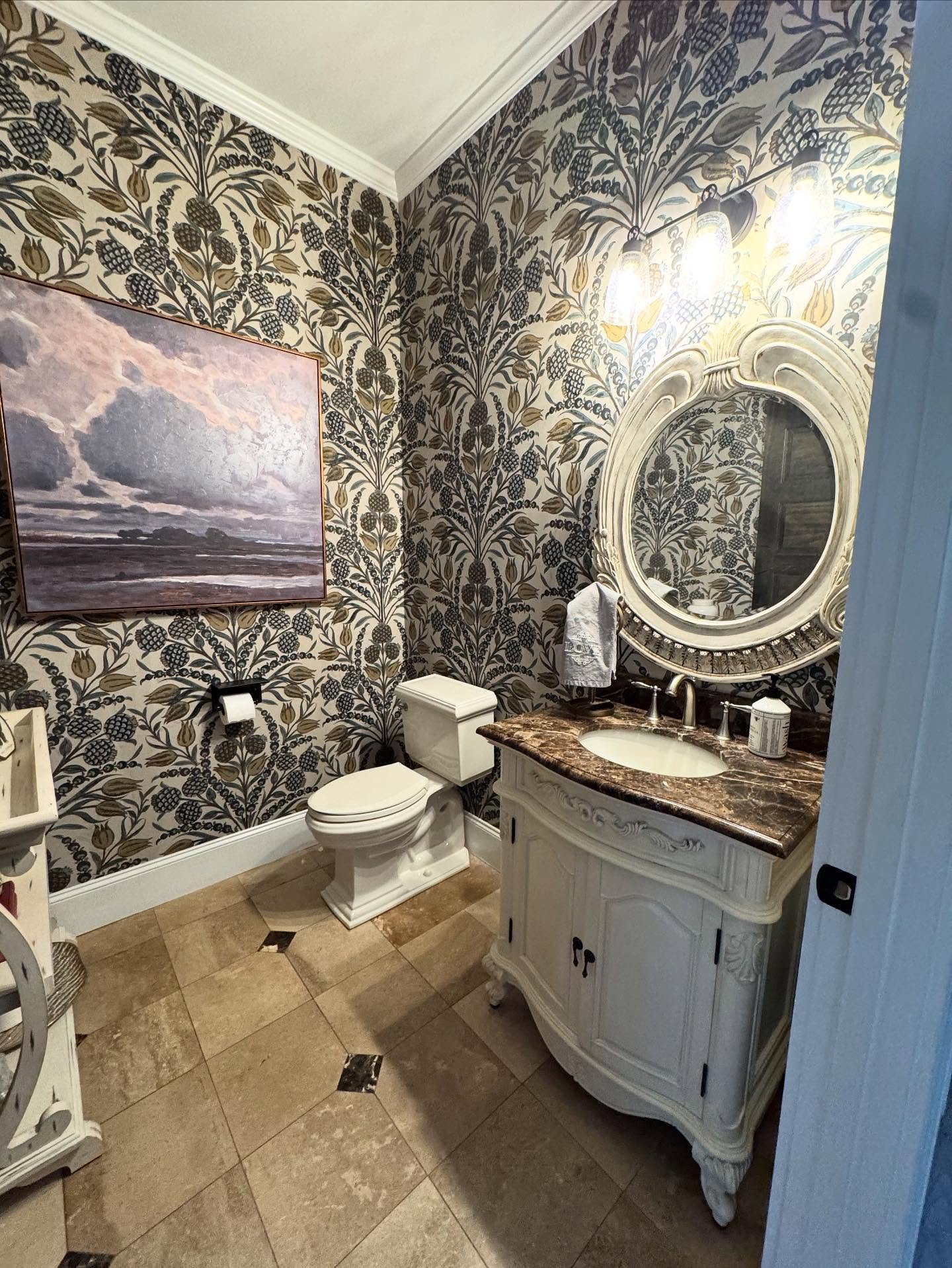
Look at the full room now and your eye doesn’t land on the floor anymore. It lands on the walls, drifts down to the vanity, over to the painting, and the travertine just belongs. The warm beige in the tile echoes the mustard tulips. The dark diamonds pick up the charcoal pineapples. The brown marble ties straight into the Give me the featured image with alt text pls
earth tones overhead. Nothing on the floor moved. Nothing on the floor had to.
See the toilet wall before and after
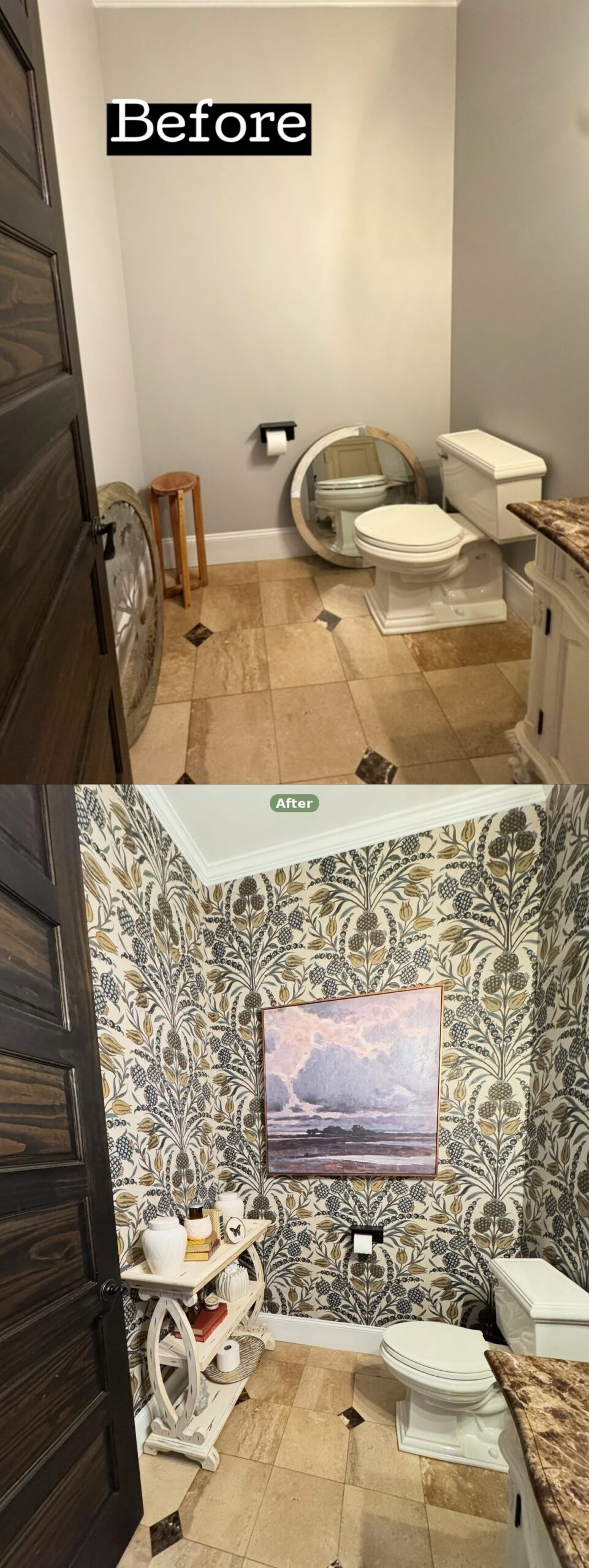
The clearest proof is the wall you see when you walk in. In the before, it’s a flat gray void. In the after, the exact same wall is holding dense wallpaper, a soft purple landscape, and a little carved shelf styled with white vases and old books. Same door. Same floor. Toilet hasn’t moved.
See the vanity wall before and after
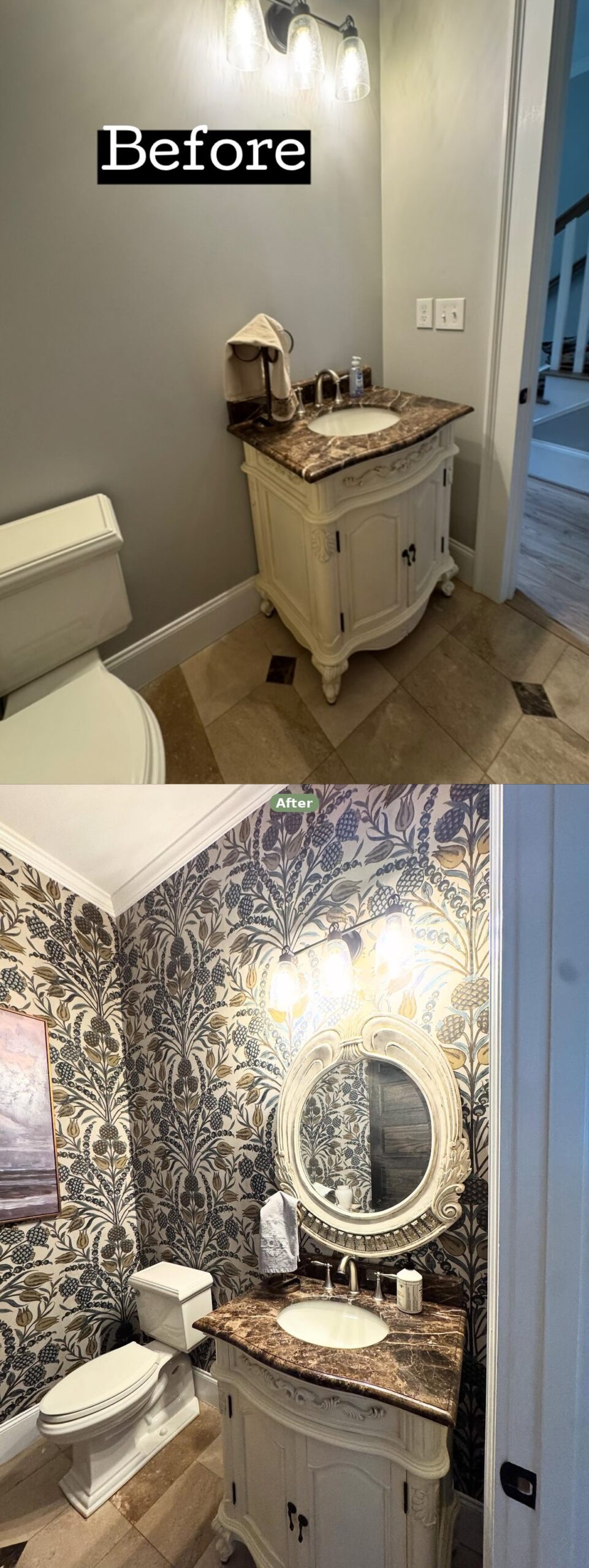
Same vanity. Same marble top. Same light fixture. The wall finally has something to say, and that oval mirror from the floor is now mounted where it was always supposed to go.
The painting that saves the room from itself
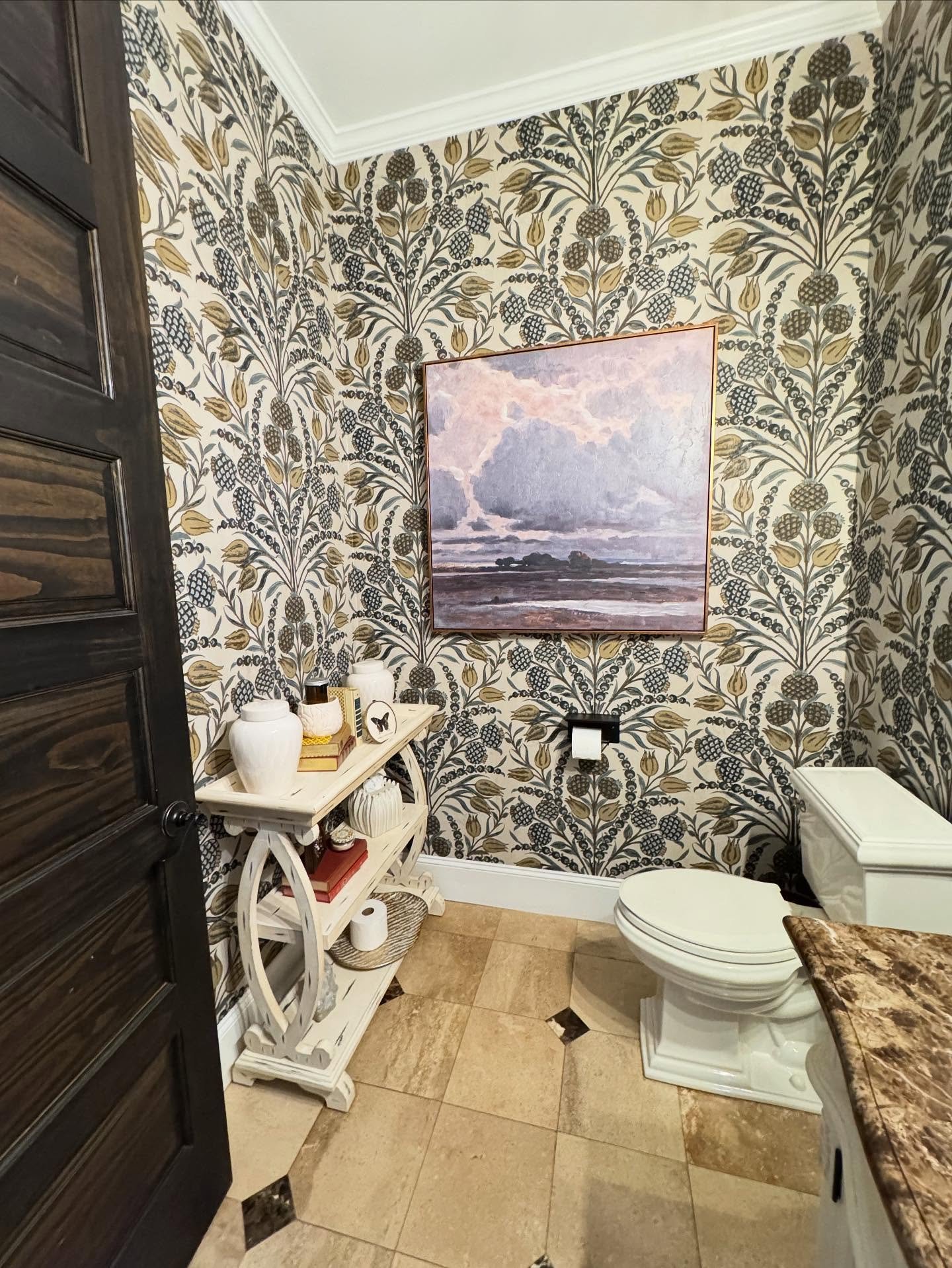
The surprise is a square landscape with soft purple clouds over a stormy coast, hung opposite the vanity. On a plain wall it would be nice art. Against this wallpaper it becomes the one place your eye gets to rest, and the pattern gets permission to keep going everywhere else. Under it sits a little cream shelf styled with white vases and old books, none of it bought for this room.
The mirror wall, up close
Walk in a little further and this is the view that sells the whole room. Three warm bulbs over a carved cream oval mirror. Dense pattern climbing the wall behind it. The brown marble catching the light. The vanity didn’t change. It just finally got a wall worth sitting in front of.
The takeaway for your own house
Before you pull up the floor you think is ruining a room, look up at the walls. There’s a very real chance the piece you want to blame is actually fine. It’s sitting in a room that isn’t backing it up.
A loud floor often needs a louder room, not a quieter one. Dated tile in a plain space reads as a regret. The exact same tile in a confident space reads as a decision.
She kept the floor. She kept the vanity, the marble top, the toilet, the light fixture, and a painting she already owned. The walls did all the heavy lifting. That’s the whole trick.