
The bedroom door has started scraping the floor, or wedging against the frame, and household wisdom has one answer: take it off its hinges, lay it across two sawhorses, and plane the bottom down. It’s a Saturday of work, it’s irreversible, and here’s what any finish carpenter would tell you before you reach for the plane: it’s almost always the wrong first move, because a dragging door usually isn’t too big. It’s hanging crooked, and the fix lives in two screws.
The diagnosis takes one look. Stand back and read the gap around the closed door: on a sagging door it’s pinched tight at the top hinge corner and at the bottom latch corner, and wide at the top latch corner, the signature of a door that has rotated slightly in its frame. The culprit is gravity working on the top hinge, which carries most of the door’s weight, year after year, until its screws loosen and the door drops out of square. Plane that door and you’ve permanently shortened a door that was never too tall; the sag continues, and next year it drags again, now with a crooked bottom.
The two-screw fix, in order
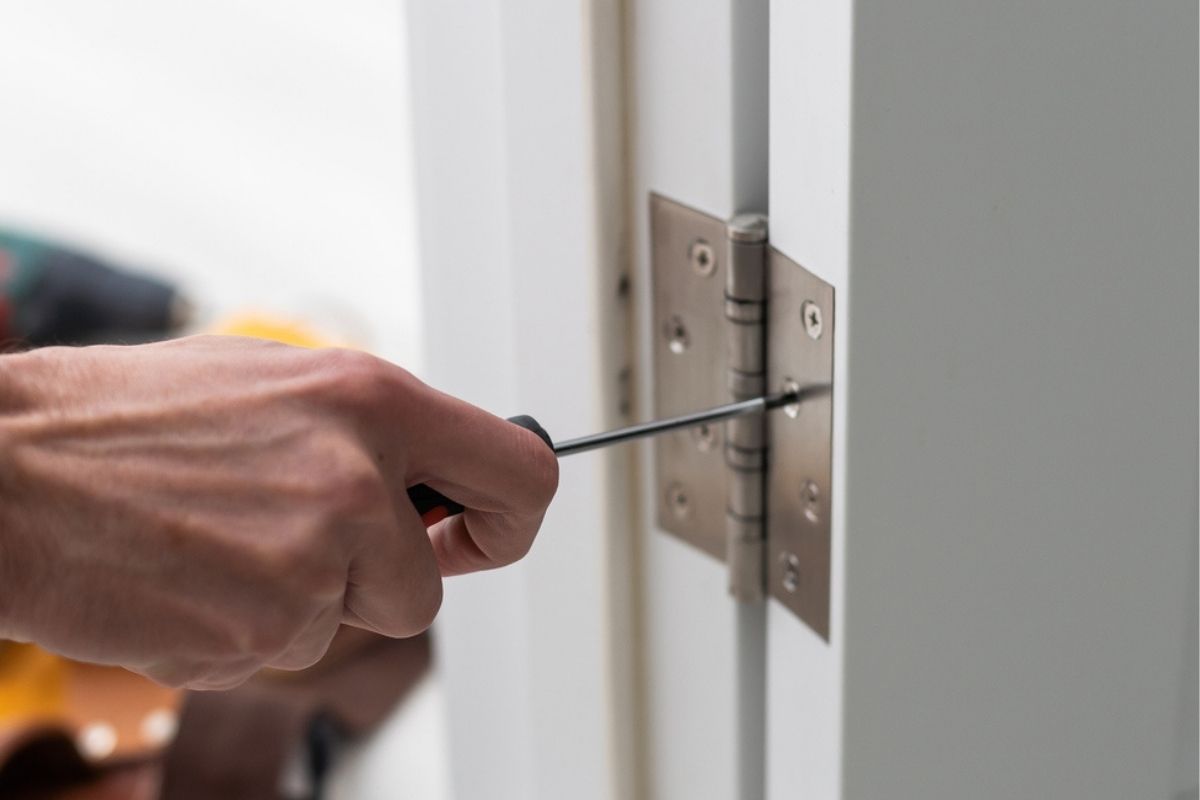
- First, just tighten. Open the door, support its outer edge (a shim or a helper’s foot underneath), and tighten every screw on the top hinge, both leaves, with a hand screwdriver, not a drill, which strips the old holes. Loose top-hinge screws cause most sagging doors, and this alone often ends the story. Test the swing.
- Then, the 3-inch screw trick. Still dragging, or screws spinning uselessly? Remove one screw from the top hinge’s frame side, a middle one, closest to the doorstop, and drive in a 3-inch wood screw. The factory screws are about an inch long and bite only the thin jamb; the long screw passes through the jamb into the wall stud behind it, and as it snugs up you can literally watch the door’s top corner pull back into square. Two screws, swapped in minutes: that’s the fix carpenters try before anything else touches the wood.
The supporting cast for stubborn doors
Stripped holes: when a screw spins forever, pull it, coat two or three toothpicks (or a golf tee) in wood glue, pack them into the hole, snap flush, let dry an hour, and re-drive; the screw bites like new. Door rubbing at the top of the latch side: shim instead: a strip of cardboard behind the bottom hinge leaf tilts the door back; rubbing at the bottom, shim the top hinge. Hinges clean but creaky: that’s a lubrication job, and the blue can is only step one of it. Only when the gaps are even all round and the door still binds, usually in a house that has genuinely settled or a door swollen by humidity, does planing earn its turn, and even then: mark the rub with chalk first, and remember the carpenter’s warning, you can’t undo a plane.
While the screwdriver’s out, give the lock strike the same minute, since a dropped door also explains a latch that suddenly misses its plate, and door hardware repays the attention.
Read the gaps, tighten the top hinge, trade one short screw for a long one. Ten minutes, no sawhorses, no sawdust, and the door swings like the day it was hung. That’s the trick.


