

There’s a bare rectangle behind the house, and for years it pointed to one obvious choice: matching concrete blocks. Now the sample board is getting crowded. The old solid grid no longer feels automatic, and the real decision starts below the surface.
Pavers still count, just not wall to wall
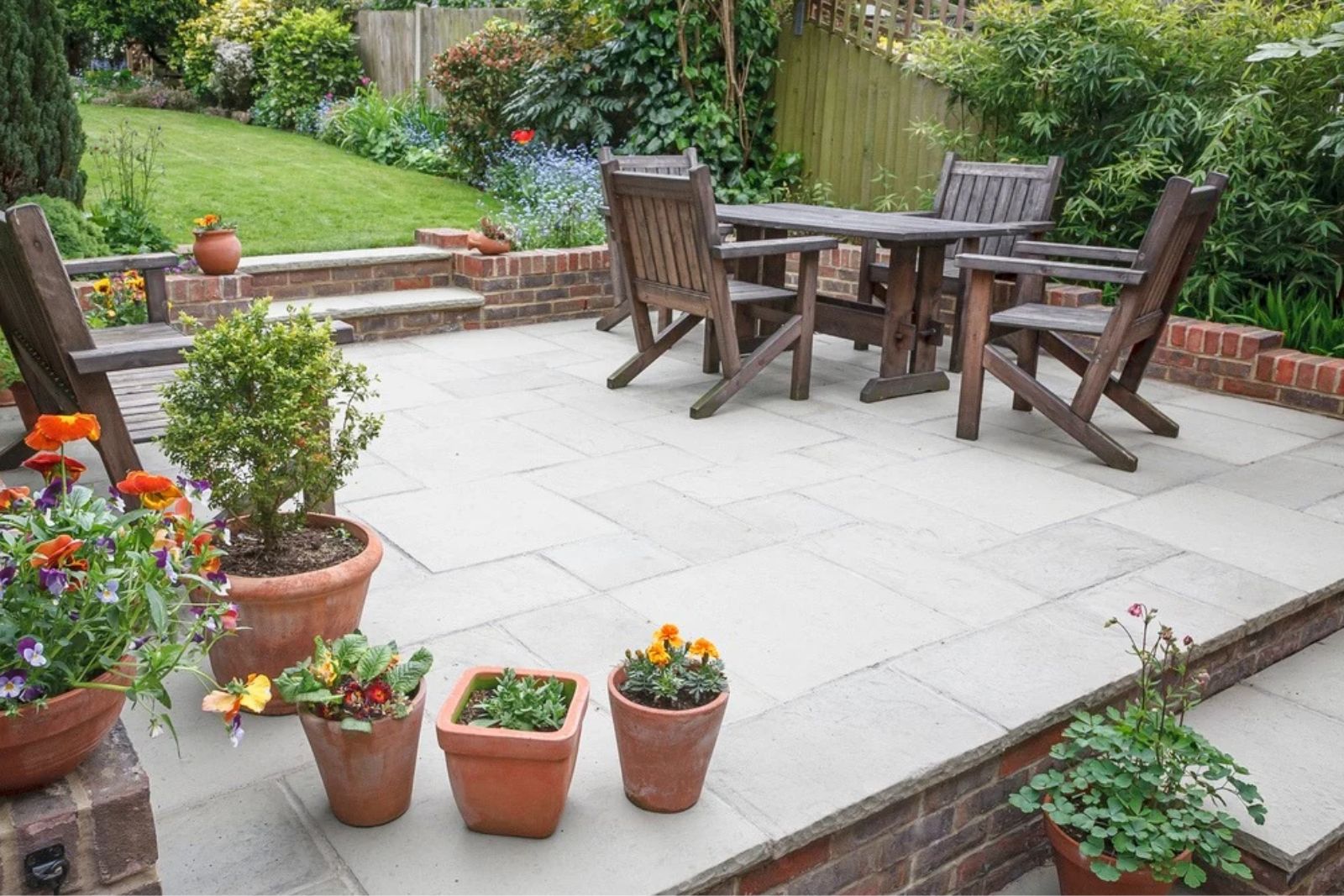
Pavers aren’t disappearing, they’re evolving and shedding the belief that you have to cover the whole patio with one tight grid. Composite decking, gravel, decomposed granite and more open paver layouts now give that bare patch several directions to go.
Often, the choice follows the way the patio meets the yard. Composite boards can suit a raised platform at the door. Compacted stone makes a seating area that feels more like a garden. Oversized slabs can sit in gravel or low planting, and even familiar blocks loosen up with wider joints filled with stone.
You can see that mix in these backyard seating ideas, where the floor frames the furniture without taking over the yard. So the question isn’t just which block to pick anymore. Which means it’s worth thinking about more than which block you like. Think about what happens under your chair when it rains.
What the rain does to a solid patio
A tightly jointed patio behaves like a shallow roof. Rain hits the hard surface, runs to the edge and can take soil and debris along with it.
Open surfaces handle it differently. The water drops through the gaps into washed stone below. The stone holds the water for a while, giving the soil underneath time to soak it up. Gravel, decomposed granite, open grids and permeable pavers all soften the look of the patio and send less water running across it.
But that open look only works if everything underneath can take the water. So before you pick a color, grab a shovel.
The test hole comes first
Before you get attached to a particular look, check the spot itself. It needs to be nearly flat, with less than a 2% slope.
Then dig a 12-inch test hole, fill it with water and let it drain. Fill it a second time. If there’s still water in it after 24 hours, pick another spot.
If the hole drains, mark out the patio and have buried utilities located before the digging starts.
- Dig deep enough for the full base and blocks. That’s often around 20 inches, but go by the manufacturer’s recommended depth.
- Tamp 12 inches of 1½-inch washed stone.
- Install geotextile only when the instructions call for it.
- Add 6 inches of ⅜-inch pea stone, then compact and level it.
- Lay the permeable blocks and sweep more pea stone into the open joints.
Where open surfaces fall short.
Loose gravel is a poor default for wheels, walkers, chair legs and snow shovels. To make it firm underfoot, you’ll usually need to make it firm and stable, add a binder or lay it over a grid. Be careful, though, because if the joints clog or the stabiliser is the wrong kind, it can end up shedding water just like a solid patio.
No permeable finish can fix a high water table, steep grade or runoff heading toward the foundation. If the test hole stays wet or digging gets close to utilities, septic components or the house, call a drainage professional.