
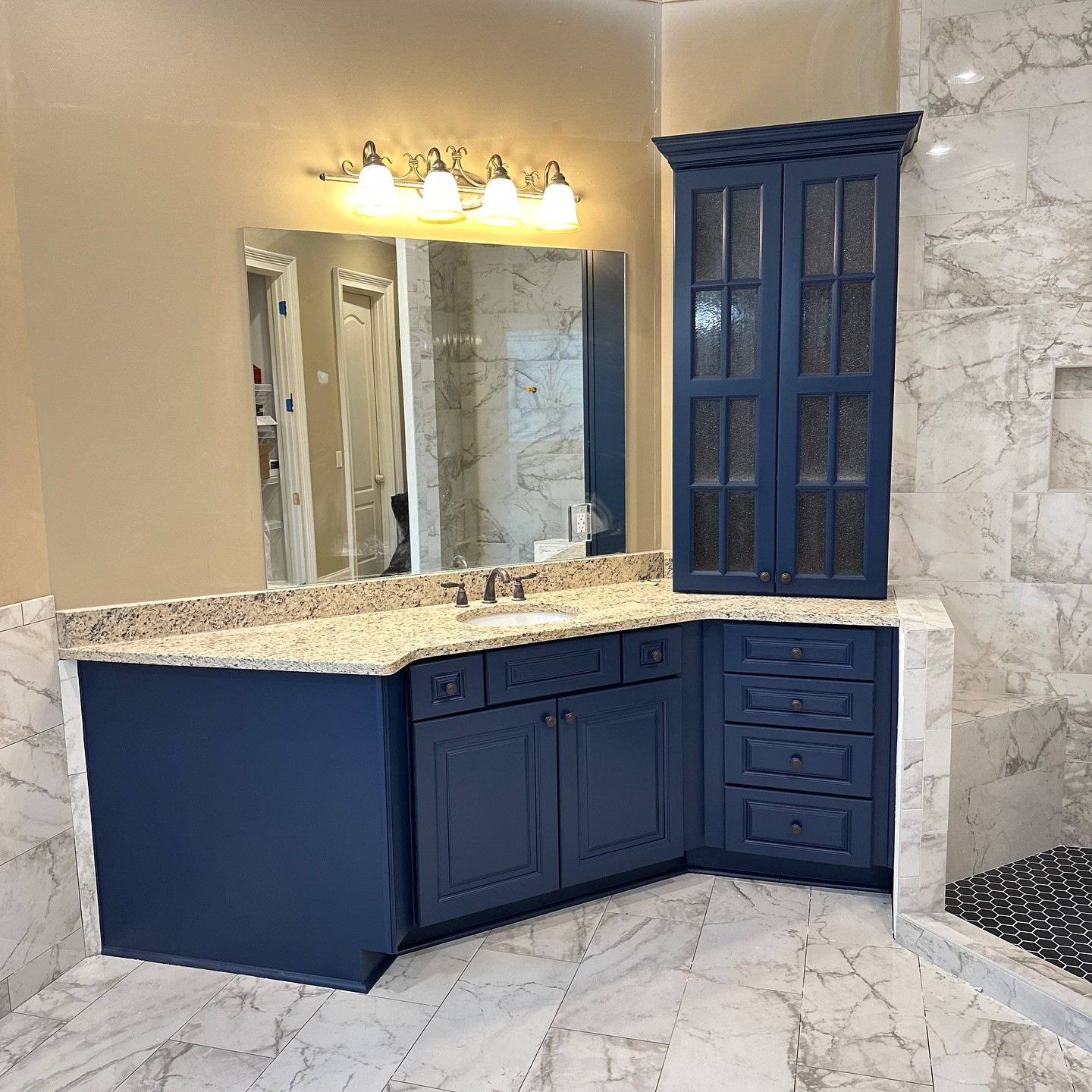
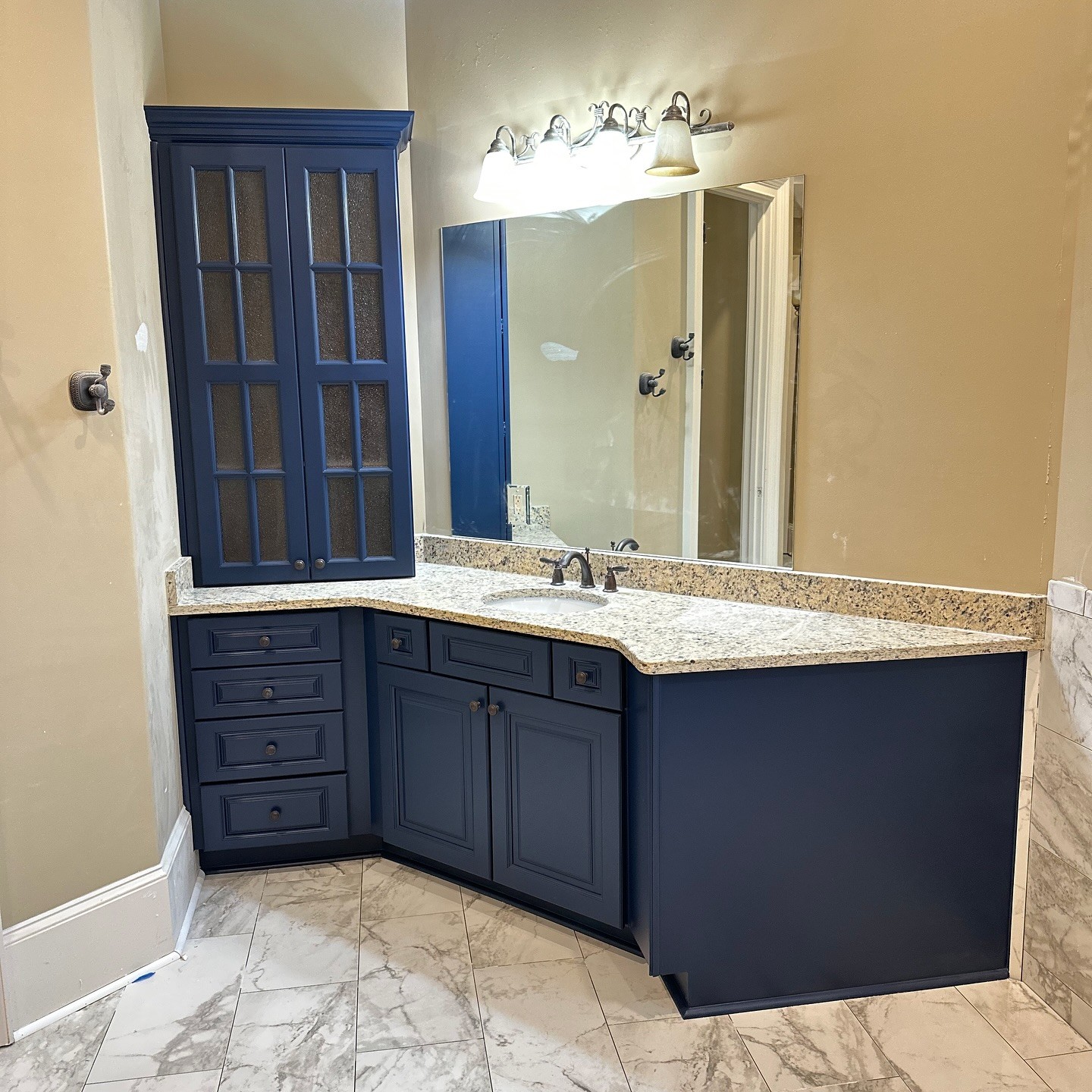
The granite in this master bathroom stayed exactly where it was. So did the mirrors, the four-light bath bars, and the oil-rubbed bronze faucets. The painter’s one change was a factory-smooth spray finish on the cabinet doors in Sherwin-Williams Naval, done on both matching vanities in the room, and that single decision rewrote how every other surface reads.
Most owners with yellow-beige granite from the early 2000s assume the stone is the thing holding the room back and quietly save for a tear-out. This story is why they probably shouldn’t.
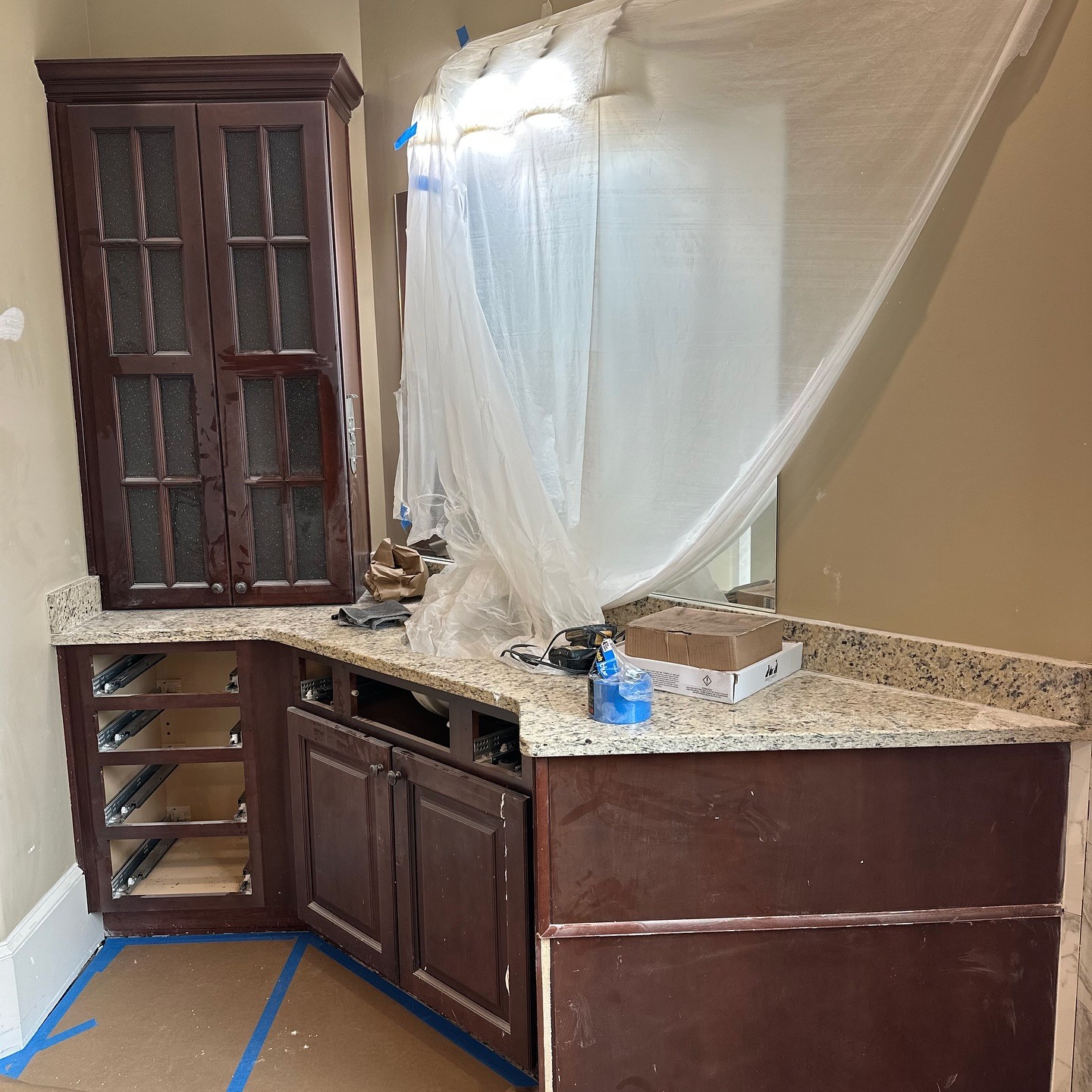
If your bathroom was built or remodeled somewhere between 2005 and 2015, this scene will look familiar: dark cherry or mahogany cabinets, a speckled yellow-and-beige granite counter (most likely Santa Cecilia, Giallo Ornamental, or Venetian Gold), oil-rubbed bronze faucet, big mirror, four-light bath bar overhead. Builders bundled this as the “upgrade” package for a decade. Millions of American homes have some version of it sitting in a primary bath right now.
By 2020, the room started feeling yellow, dated, and heavy. The owner looks at the counter and figures the granite is the problem. Pricing goes out for new quartz. Sometimes the whole vanity is on the chopping block. A full counter swap in natural stone or quartz usually runs $3,500 to $6,500 (about €3,240 to €6,020) installed for a vanity this size. A full vanity-and-counter replacement is closer to $8,000 to $15,000 (about €7,400 to €13,880) before you touch tile or plumbing. In a double-vanity bath like this one, double that.
The actual culprit sits six inches away
Cherry and golden granite share the exact same warm, orange-red undertone. Sit two warm colors next to each other and they don’t cancel out. They amplify. The brown cabinets were pulling every drop of yellow and gold out of the stone and bouncing it right back into the room. The granite was reading more yellow than it actually is. The cabinets were reading more orange than they actually are. Everything blended into one warm, beige-gold mass, which is exactly what a modern eye registers as “old house.”
So the fix was never to replace the loud yellow thing. It was to change the color sitting right next to it.
Side by side, same corner
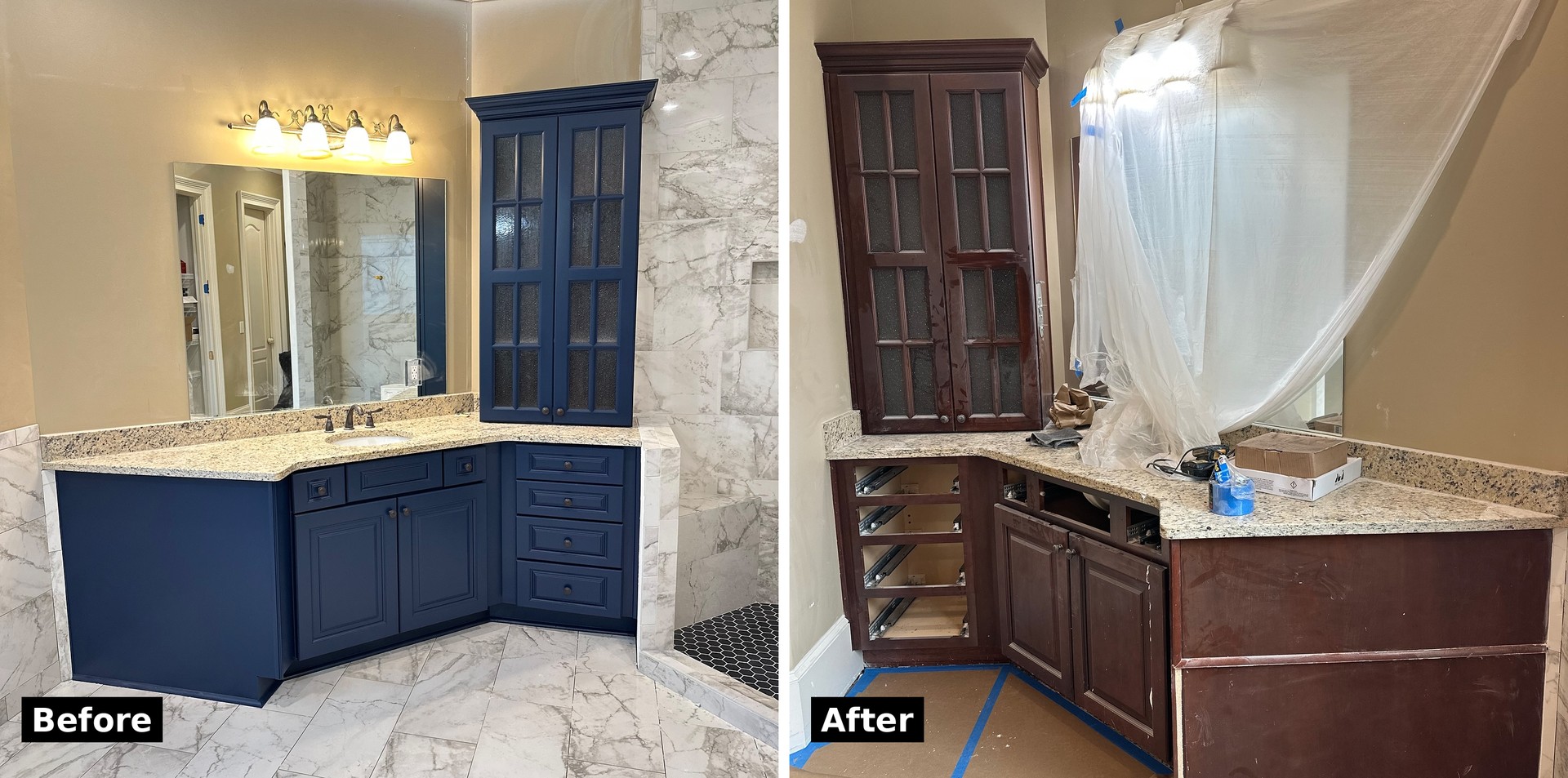
Look at the tall cabinet with the small glass panels. Same cabinet. Look at the drawer stack below it. Same boxes, now with their fronts back on. Look at the counter. Same slab, right down to the pattern of specks. The painter spec’d Sherwin-Williams Naval (SW 6244), prepped and primed every door and drawer face, sprayed them for a factory-smooth finish, and reinstalled. That was the job.
One coat of Naval, and the stone looks like a different slab
Look at the counter now. The cream specks jump forward. The yellow drops back. The whole slab feels soft and almost travertine-like under the cool cabinets. The oil-rubbed bronze faucet stops looking muddy and starts reading as intentional warm metal against a cool cabinet. The mirror feels framed even though nobody added a frame.
That isn’t a new slab. It’s the same granite from the “before” shot, with a different color above it.
The matching vanity across the room got the same treatment
This is the second vanity in the same bathroom, built as a mirror image of the first (tall cabinet on the right instead of the left). Same granite slab pattern. Same hardware. Same oil-rubbed bronze faucet. Same four-light bath bar. The marble tile wall you can see on the far right is the shower surround, which gives the finished bathroom that extra layer of cool material to play against the navy.
Why Naval, and not just any navy
Not every blue would have done this. A dusty blue or a smoky slate would have gotten lost against busy speckled stone. A true black would have felt heavy and crypt-like in a bathroom this size. A trendy moody green might look dated again by 2029.
Naval sits in a very specific sweet spot. It’s a true navy, not a blue-gray, not a blue-black. Dark enough to feel expensive. Saturated enough to hold its own against busy granite without fighting it for attention. Cool enough to visually neutralize all the warm yellow bouncing off the stone. Deep navy has held up as a cabinet color for a century, from classic kitchens to shaker libraries, so you aren’t walking into a three-year expiration date the way you would with some of the trendier blues.
The quote to get before you call the countertop guy
If you’ve been quietly hating your yellow granite for years, the granite probably isn’t the problem. The color sitting next to it is.
Get a quote for a professional cabinet spray job before you get a quote for anything else. For a bathroom vanity this size it usually runs $600 to $1,500 (about €555 to €1,390) including prep, priming, and a factory finish. That’s a fraction of what one new countertop alone would cost. It keeps a perfectly good slab of natural stone out of the landfill. And the room can read like a different bathroom in a weekend.
Same granite. Same vanity. Just Naval.