It’s one of the cheapest energy upgrades there is: a reflective panel slipped behind the radiator to bounce heat back into the room instead of letting it soak into the wall. Millions are fitted every winter, and a surprising share of them are doing almost nothing, because their owners made a mistake the packaging barely warns about: a reflector panel only works one way round, and plenty are sitting behind radiators backwards.
The principle first, because it explains the rule. A radiator on an outside wall sends a large share of its output backwards: up to 40 percent of its heat goes into the wall behind it, and on an uninsulated exterior wall much of that simply leaves the house. A reflective panel in the gap intercepts that radiant heat and returns it, and the physics is real: tests have measured heat loss through the wall behind the radiator falling to less than 30 percent of its original value, with room energy savings of up to 6 percent, and the worse the wall’s insulation, the bigger the gain.
Which side faces the room
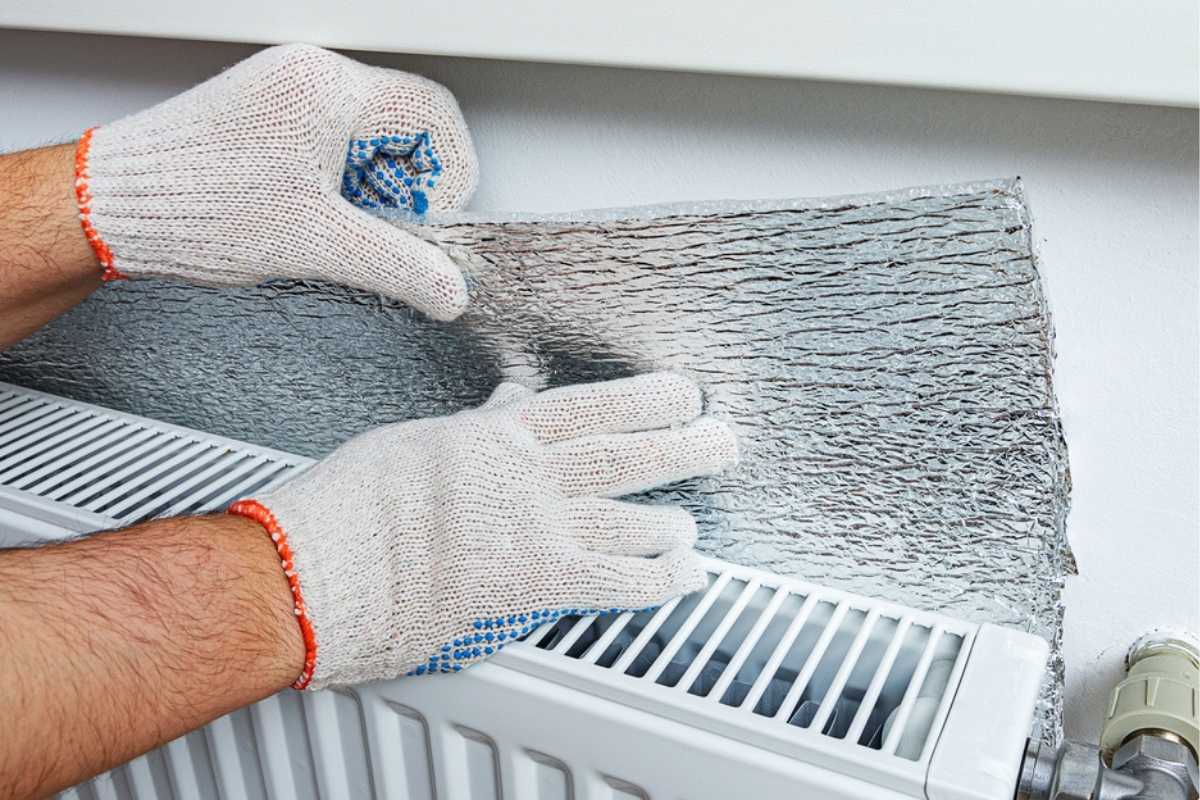
The rule: the reflective face must look at the radiator, out toward the room, never at the wall. Radiant heat bounces off the surface it hits; a panel turned around is just a sheet of backing material, reflecting nothing anywhere useful. For ordinary foil panels that means the shiny side faces forwards, toward the back of the radiator, and any printing, branding or adhesive side faces the wall.
One honest wrinkle keeps this from being a pure “shiny side out” slogan: a few engineered panels deliberately put their heat-reflecting surface under a matte coating, and the best-known brand instructs that its matt face goes toward the radiator, because it reflects heat better than its shiny printed side. So the universal rule is really this: the face the maker designates as reflective looks at the radiator; with a generic foil, that’s the mirror-bright side, and with a branded panel, the printed side is always the wall side. The quick check takes five seconds: peer down the gap, and you should see the unprinted, radiator-facing surface, bright on a generic panel, and never any branding looking back at you.
Fitting it so the physics can work
- Only behind radiators on exterior walls, ideally uninsulated ones; on a well-insulated or interior wall the gain shrinks toward nothing, since there’s little loss to rescue.
- Keep an air gap. The panel hangs in the space behind the radiator, not glued flat to the wall across its whole face: the gap is part of the insulation, and airflow behind the sheet also prevents trapped damp, the one way these panels can feed the mold problem rather than your comfort, a cold-wall story of its own.
- Cut it slightly smaller than the radiator, so it stays invisible, and don’t block the valves or the airflow underneath.
- Use a real reflector panel, not kitchen foil: cooking foil oxidizes within a season or two and quietly stops reflecting, the false economy specialists keep warning about.
Fitted right, on the right wall, the panel earns back its few dollars within a winter and then keeps paying, one of the small corrections, like getting the thermostat number right, that add up to a noticeably cheaper season. So tonight, five seconds per radiator: look down the gap. If the panel’s branding is smiling back at you, it’s been warming the wall all along. Turn it around, and let it finally face the room it was bought for.