A homeowner in Rotherham was done with her cream gloss kitchen. The shiny doors showed every fingerprint. The chrome handles screamed “builder spec.” The whole room felt like a hand-me-down from 2015, even though nothing was broken.
She did not rip anything out. She did not call a kitchen contractor. She kept every cabinet box, every door, every appliance, the backsplash, and the floor tile. She brought in a mobile sprayer, picked Farrow & Ball Beverly Green in a matte finish, swapped the chrome pulls for brushed brass, dropped in new light oak counters, and ended up with a kitchen that looks like a different house.
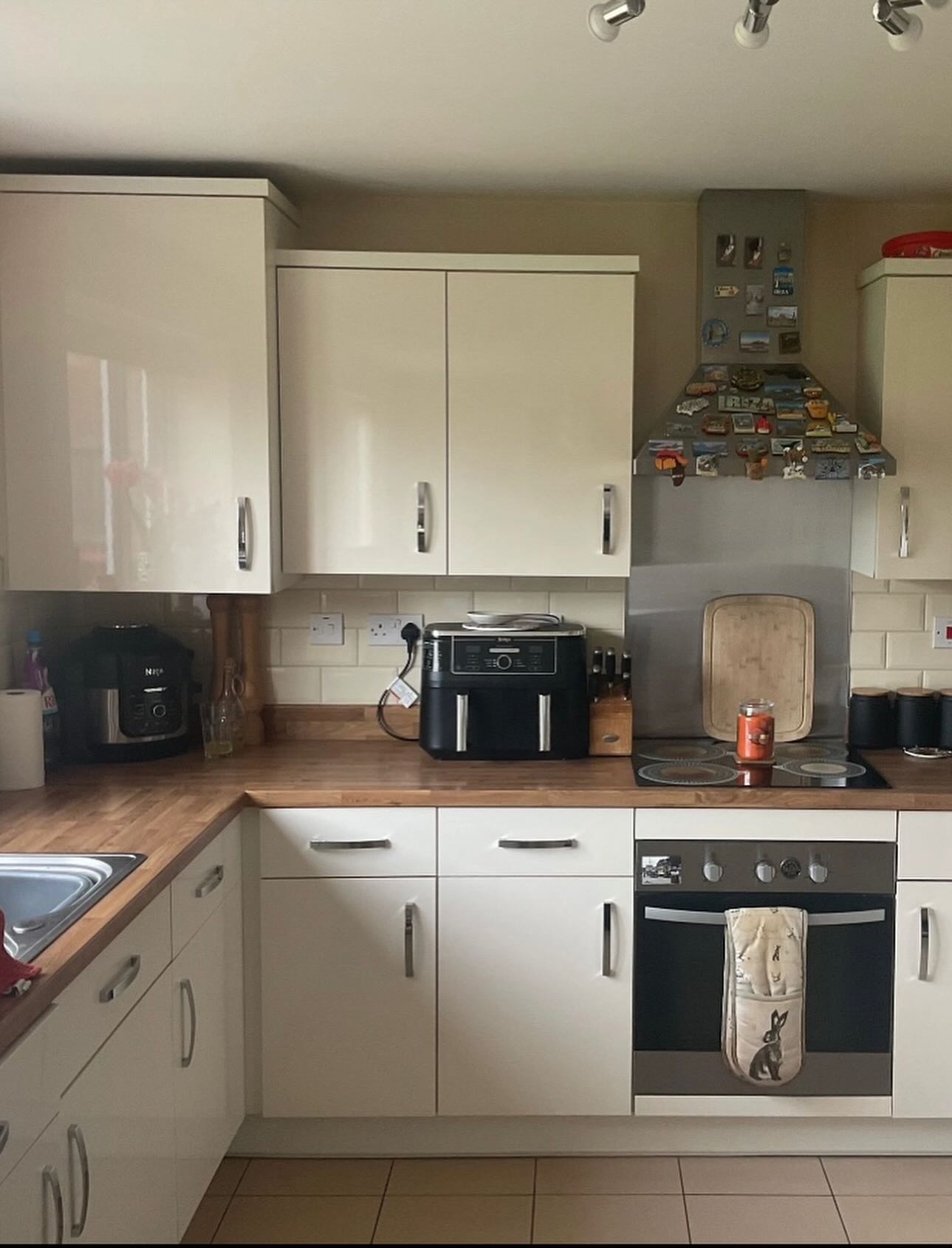
Here is what she was living with.
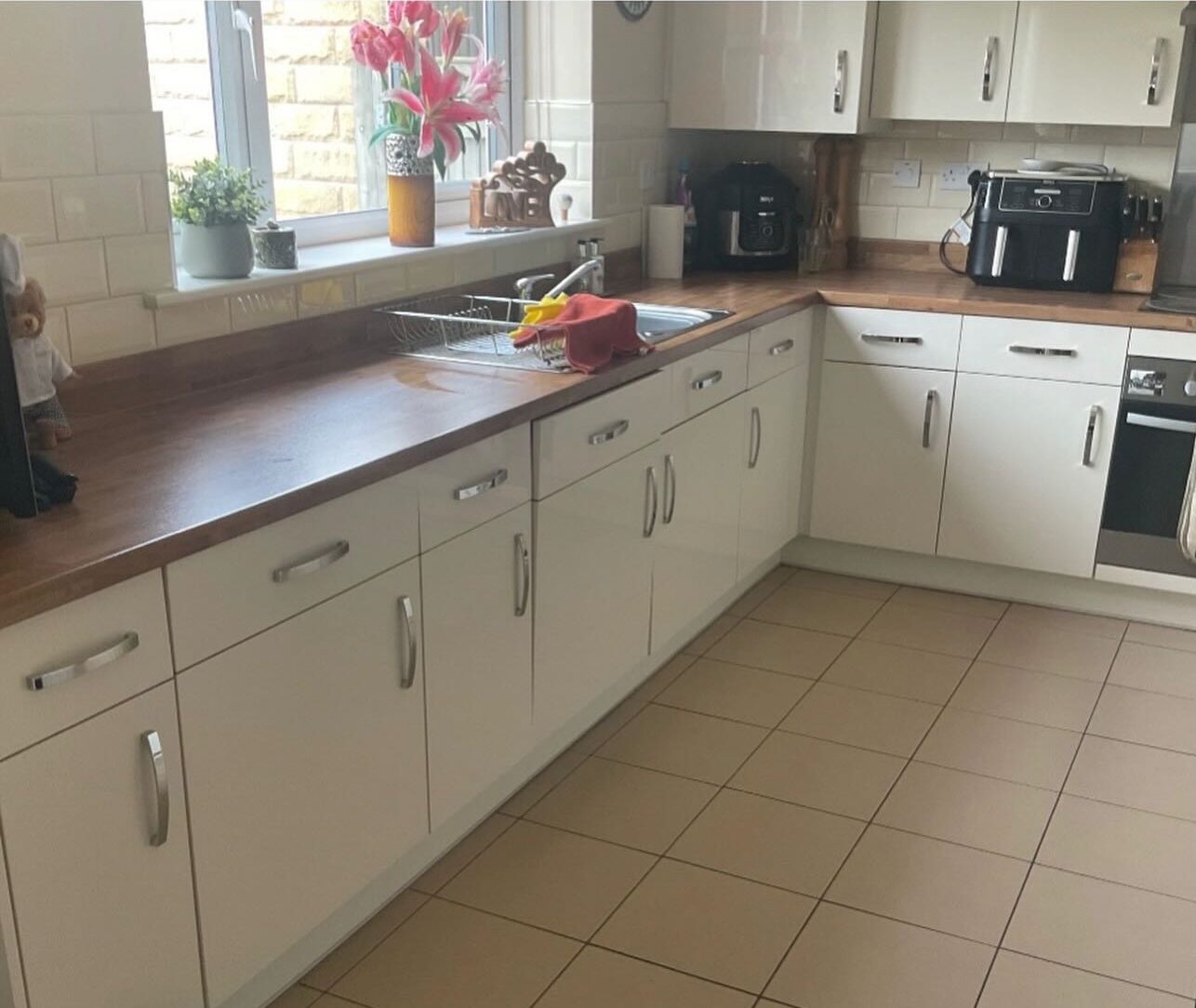
If that kitchen looks familiar, it should. Cream high-gloss cabinets with chrome bar handles were the default fit in US tract homes and UK new-builds from about 2012 to 2019. Millions of people are still living inside that choice today, and most of them think the only way out is a $12,000 (about £9,000) rebuild.
She proved that wrong in a few days with a sprayer, a pack of handles, and new oak counters.
The sprayer taped off the whole room and left the cabinets in place
Before any color went on, the sprayer wrapped every counter, cooktop, oven and bit of backsplash in plastic. The floor got brown paper. The cabinet doors came off and lined up to spray flat. The boxes stayed bolted to the wall.
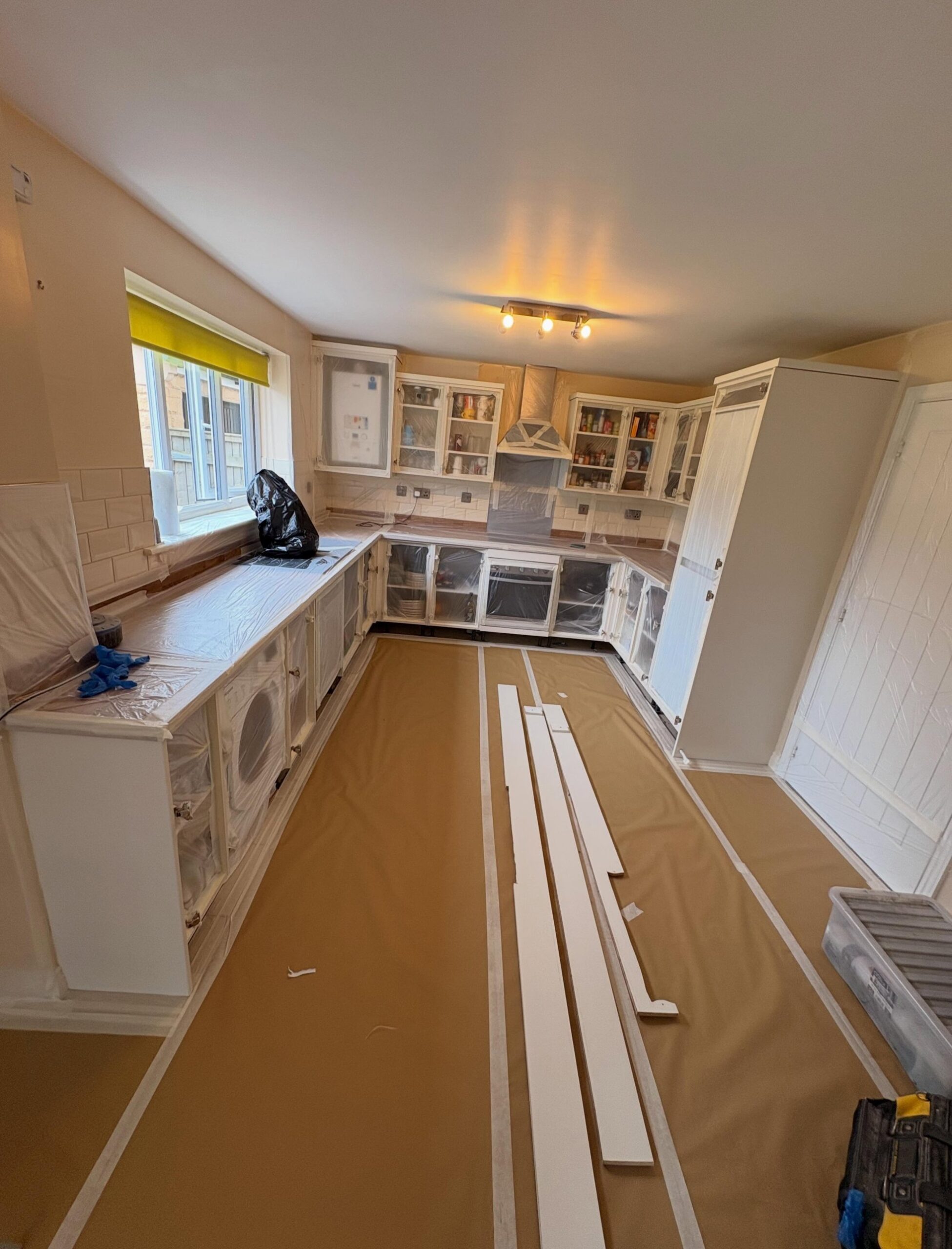
This is the part most people get wrong when they try to brush-paint a kitchen themselves. Brush strokes show. Rollers leave orange-peel texture. A proper spray job lays the paint down flat, so the finished door looks factory-made, not DIY. Farrow & Ball Beverly Green in matte was the color pick. It is a deep, slightly dusty forest green, not sage, not olive, not hunter. In matte, it soaks up light instead of bouncing it. That one choice is what makes a flat-pack door photograph like something you would see in a show home.
Same room, different century
Look at the sink wall now. Same window. Same yellow shade. Same white subway tile. Same black sink. Same floor tile. The cabinet boxes are the same, in the same spots. The color on the doors changed, the pulls changed, and the dark walnut counter was swapped for a light natural oak that lets the green do the talking.
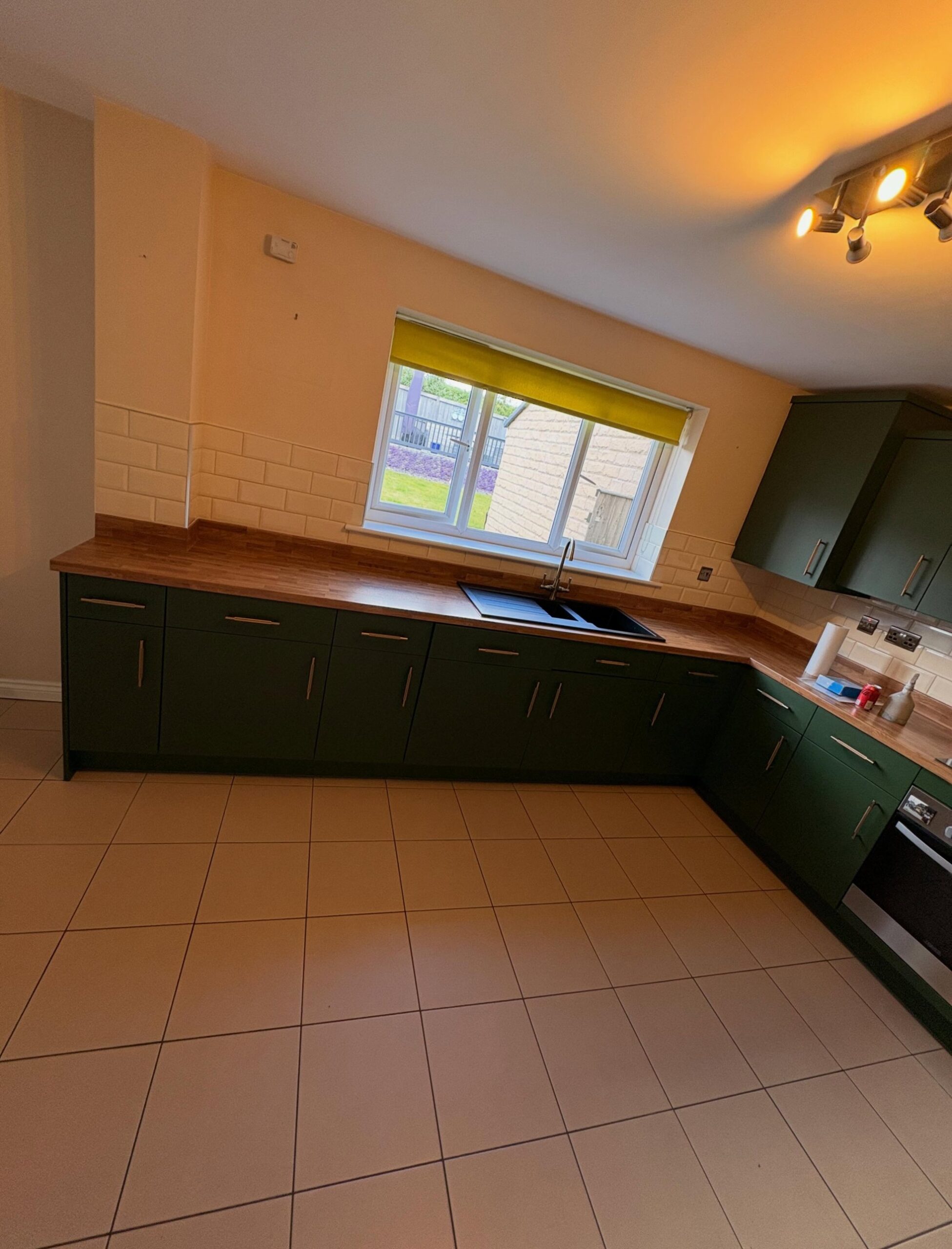
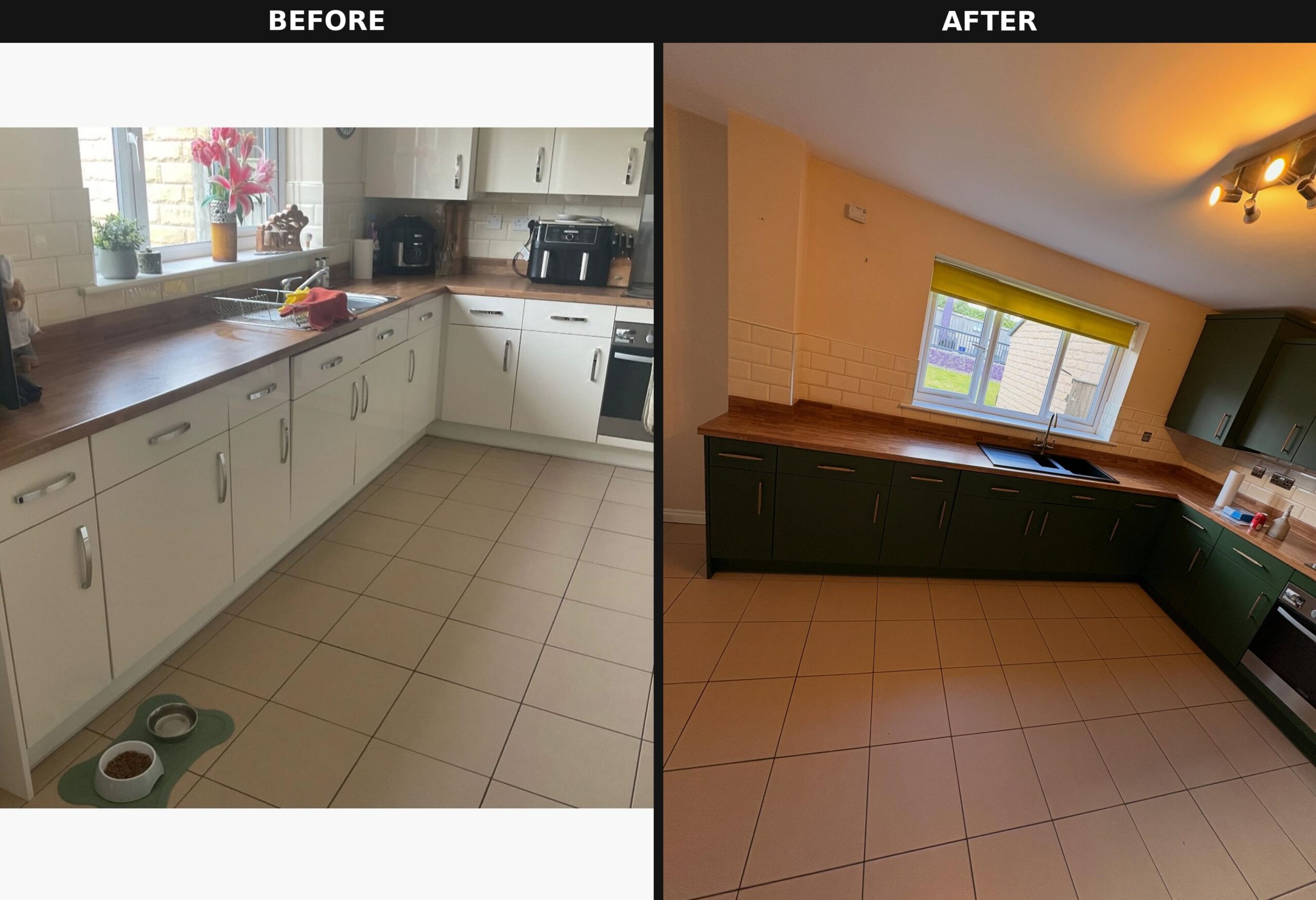
The cream version read anonymous. The green version reads like somebody chose it on purpose. That is the whole trick.

The cooktop wall tells the same story
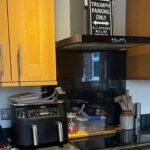
The old cooktop wall was fighting with itself. Cream gloss doors tried to look clean. Travel magnets covered the hood. The air fryer and the dark oven cut hard lines against the shiny light cabinets. Nothing on that wall agreed with anything else.
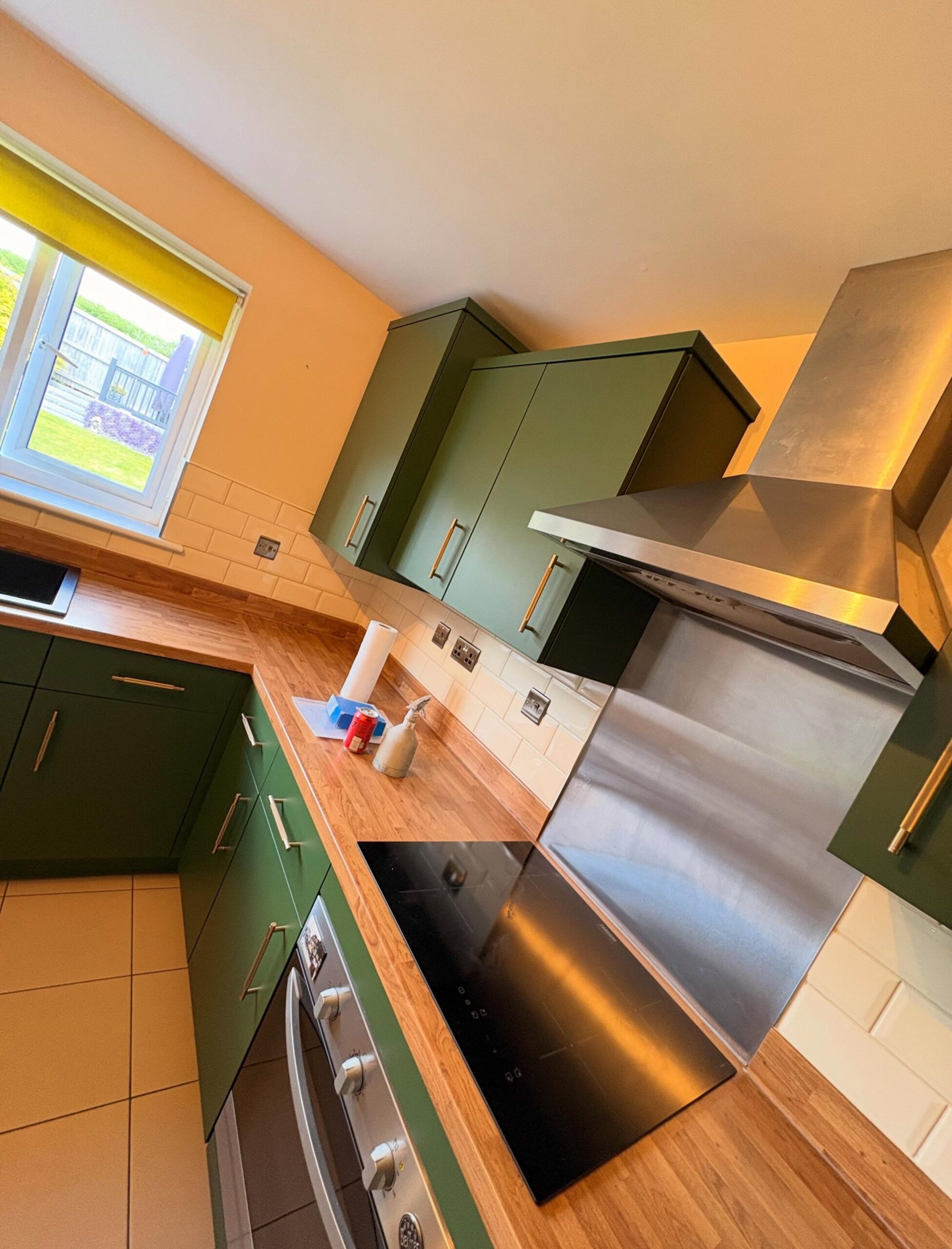
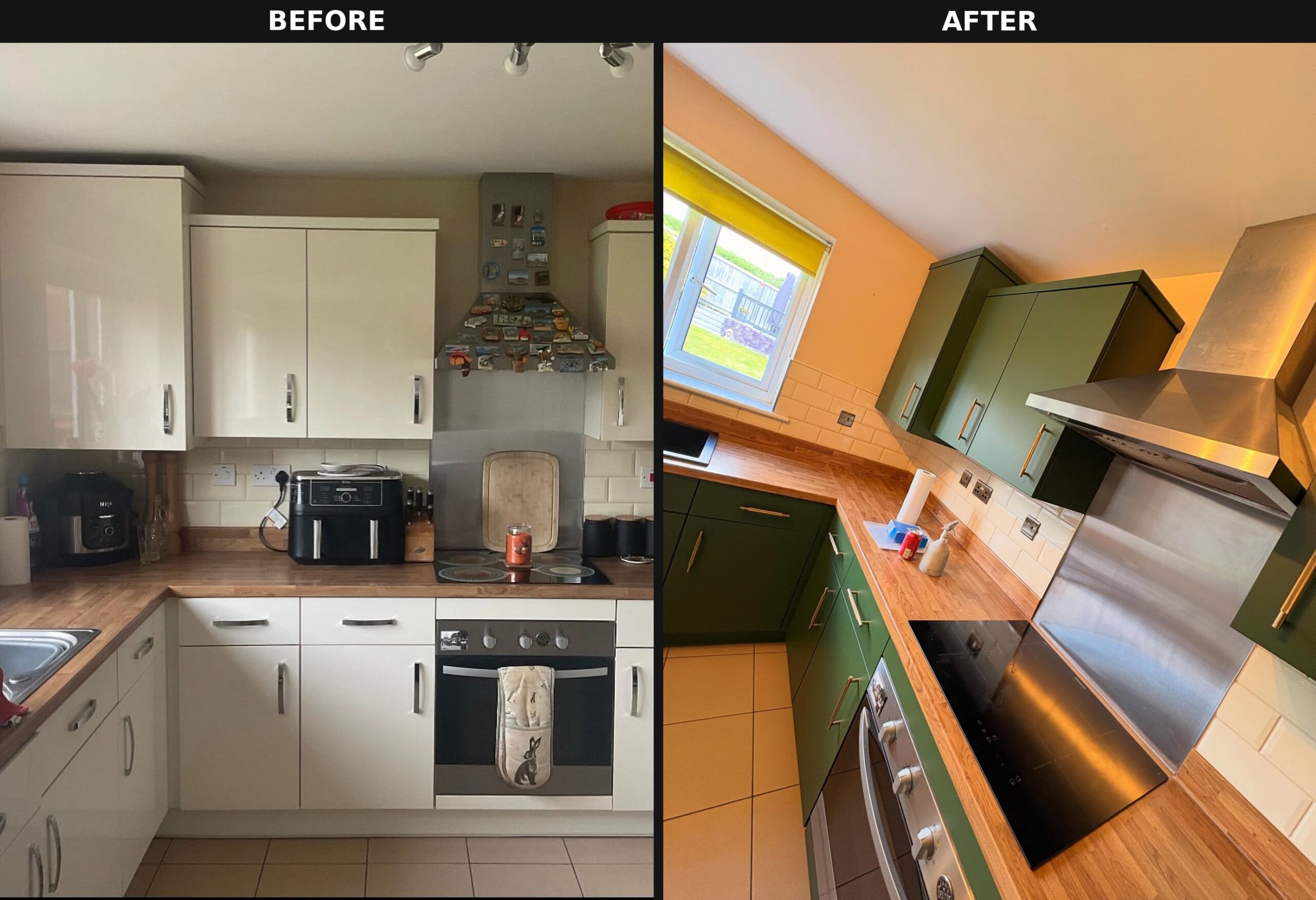
Clear the magnets, drop the brass pulls in, and suddenly the hood is a feature instead of a bulletin board. The oven looks grown-up. The new light oak counter warms up the whole wall where the old dark one used to compete with everything on it.
The pantry corner is where the price shows up
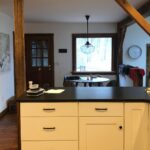
A tall pantry cabinet is the single most expensive piece in a new kitchen. Replacing one with a fitted equivalent usually runs $500 to $1,000 (about £380 to £760) before install. The homeowner kept hers. Same box, same hinges, same shelves inside. All she changed was the outside.
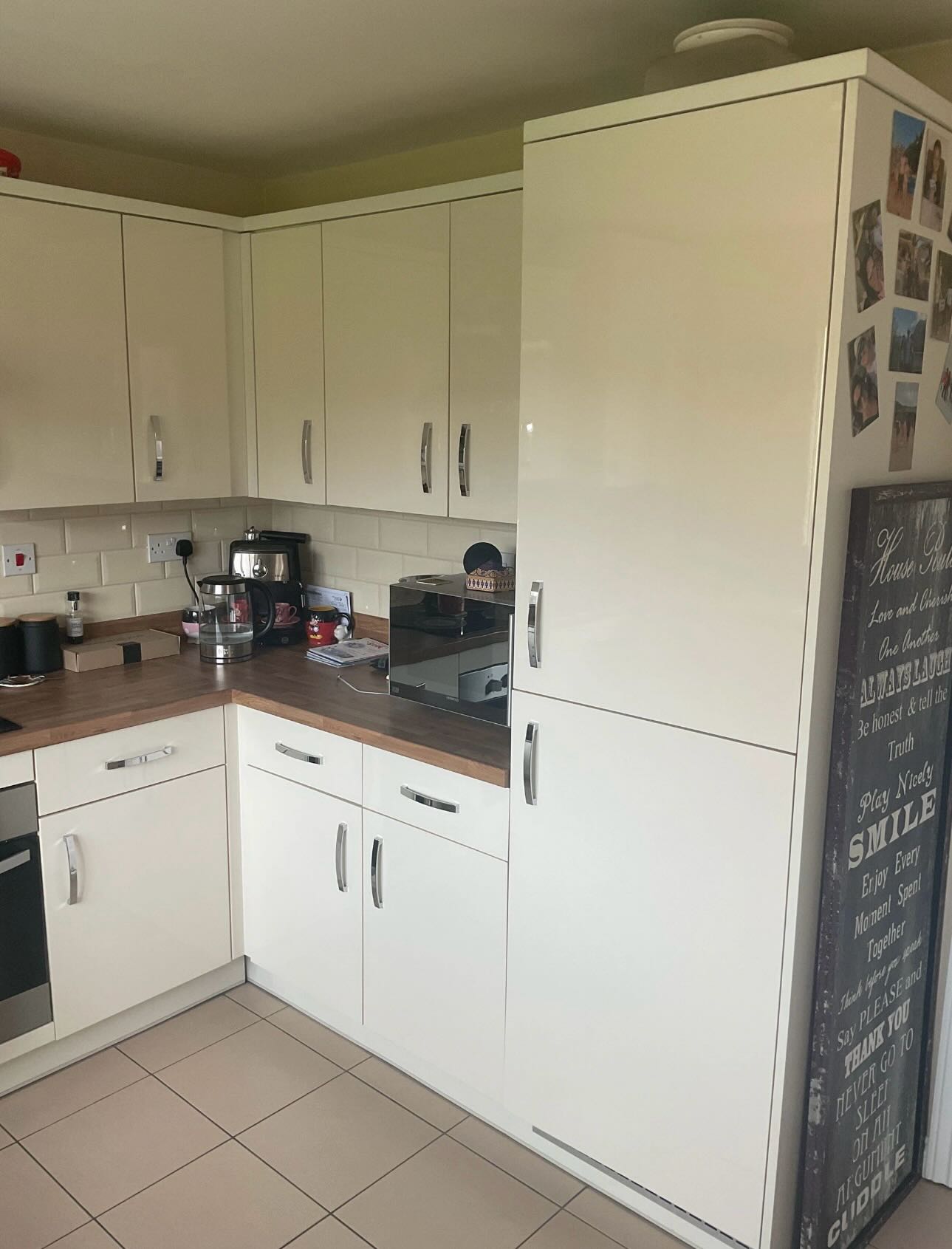
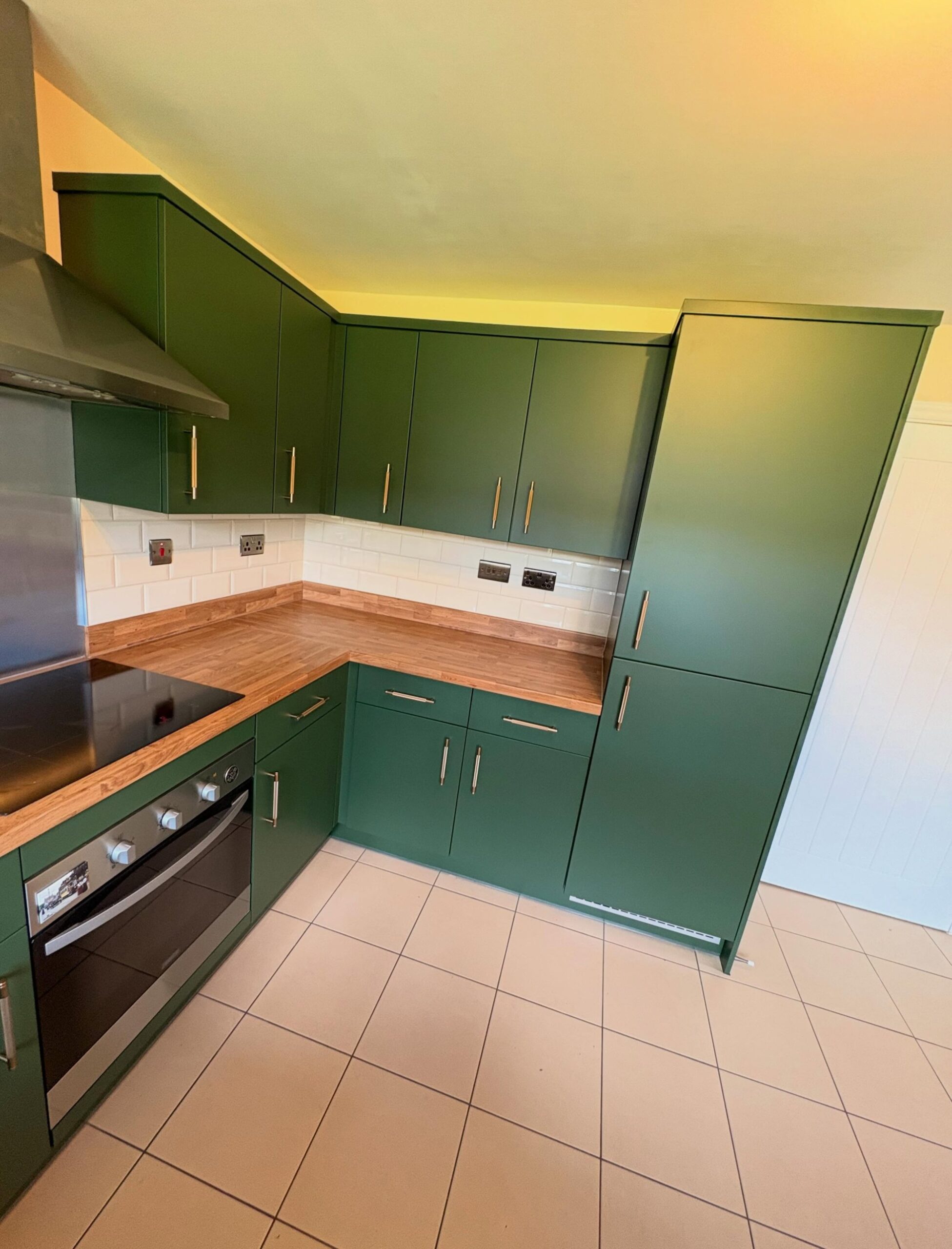
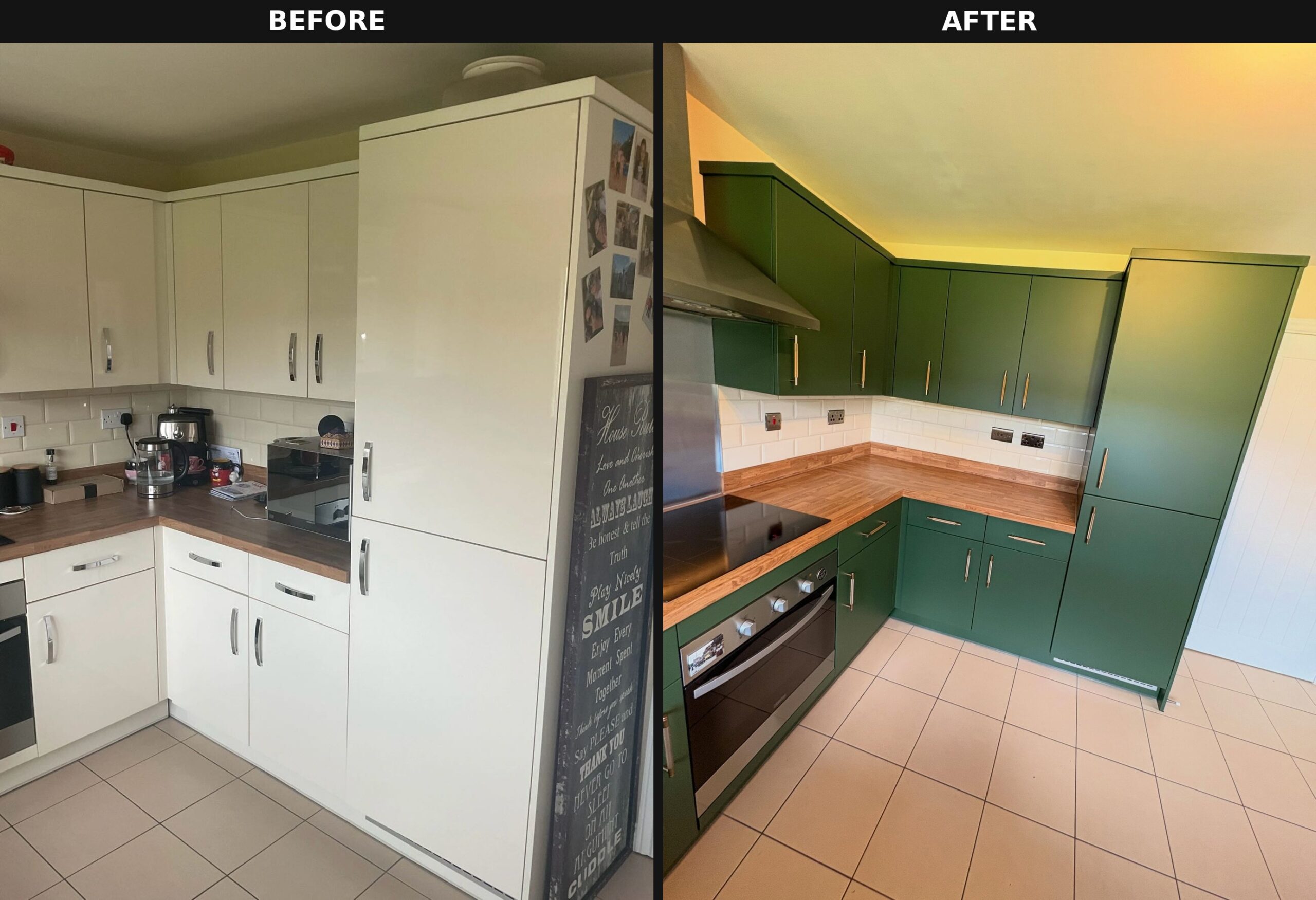
Nothing on the back wall changed either. The sloped ceiling is the same. The outlet positions are the same. If you squint, this is literally the same cabinet from the “before” shot. The green and the brass do all the work.
The wide shots are where it clicks
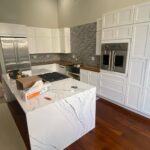
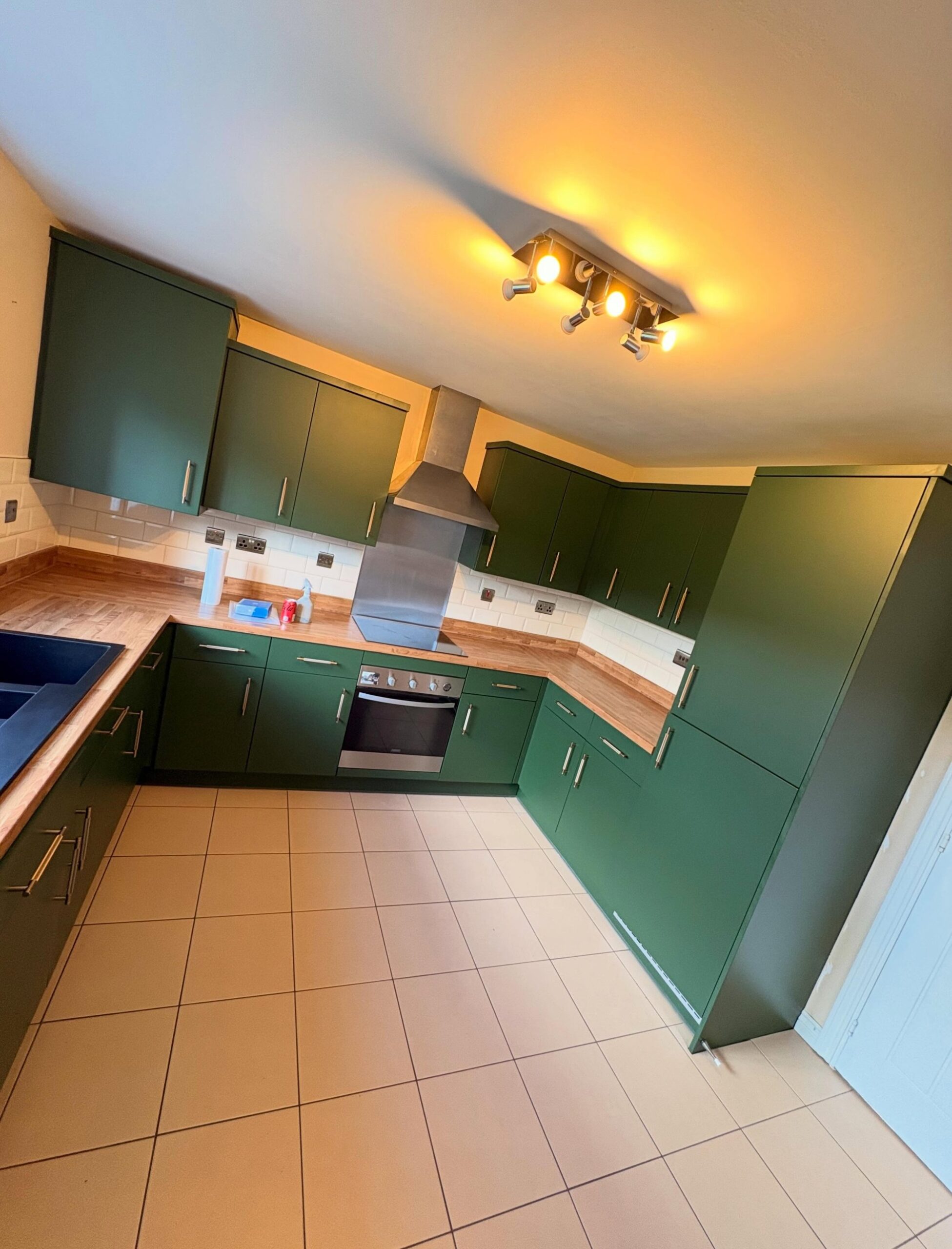
Pull back and the whole U-shape reads as one room now. Deep green on the lower cabinets grounds the floor. Deep green up top wraps around the ceiling line. The oak counter runs clean through it. The white backsplash separates them. It feels designed, not installed.
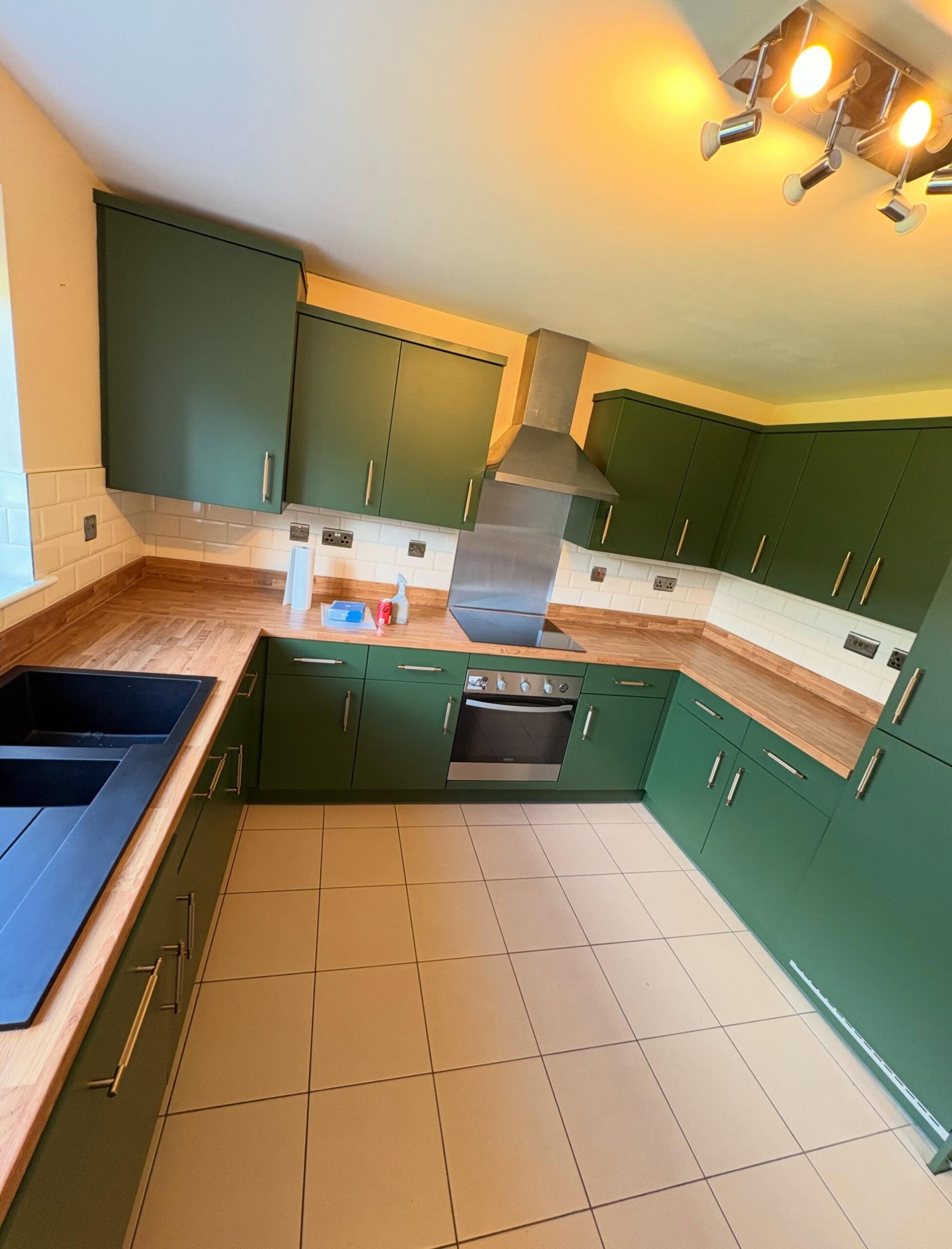
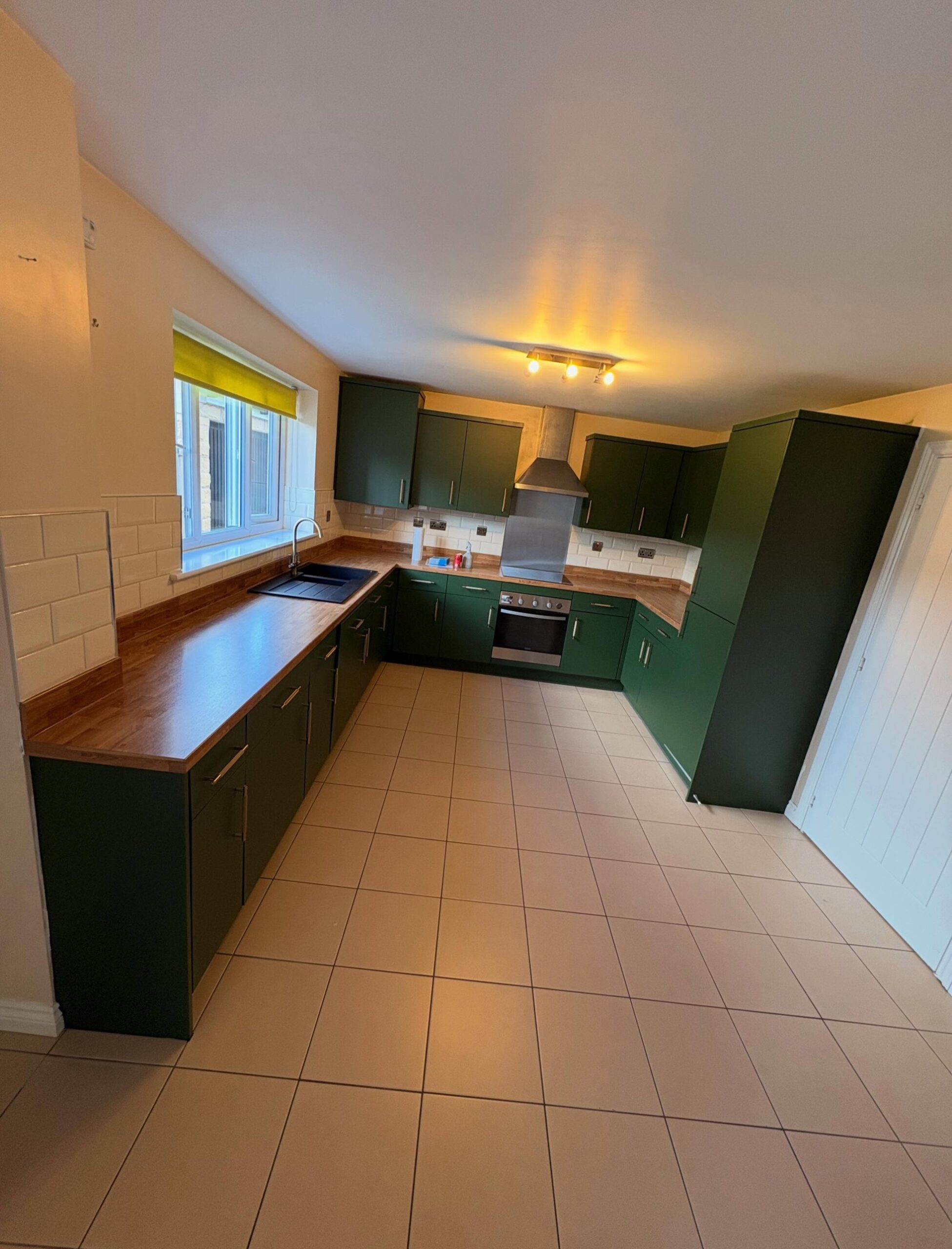
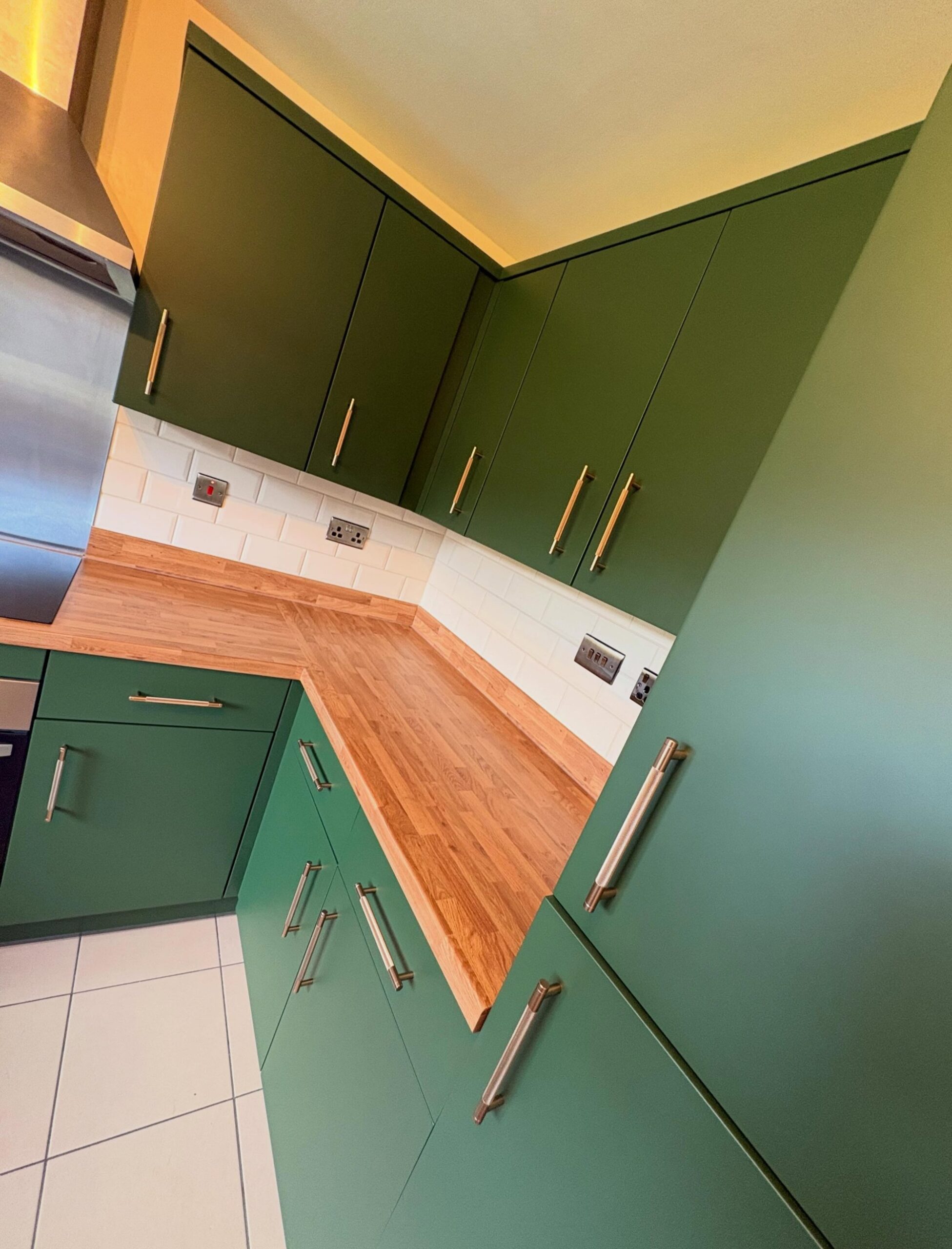
Close up, the brass handles do the finishing work. Brushed brass bar pulls are what you see on $40,000 (about £30,000) custom kitchens from Devol and Plain English. Drop them onto flat-pack cabinets at the right scale and your eye reads the whole room as expensive.
What this actually cost her, versus what it did not
A professional respray at this scale runs about $1,300 to $3,300 (about £1,000 to £2,500) depending on cabinet count. Brass pulls for a kitchen this size are $130 to $330 (about £100 to £250). Light oak counters for a U-shape add roughly $600 to $1,200 (about £460 to £910) in material. A full rip-and-replace of this same kitchen, installed, would be $10,000 to $20,000 (about £7,600 to £15,000), closer to $25,000 (about £19,000) if she had changed the layout.
She still saved roughly 70 to 80 percent. She kept her oven, her cooktop, her hood, her sink, her tiles, her floor, and every cabinet box. She did not live out of the microwave for six weeks while a contractor tore up the room.
The reason this story matters is not the color. Cream gloss aged badly because gloss on a flat door bounces every ceiling light and shows every scratch, not because of anything cream did. Any flat gloss slab in any color was going to date. If you have one of these kitchens and you have been quietly hating it, the exit is not a dumpster and a rebuild. It is a sprayer, a weekend of masking, new pulls, and a fresh run of counters.
The cabinets you already own are mostly fine. They just need to stop being shiny.