Behind the TV stand, under the desk, next to the kitchen counter: almost every home has at least one power strip wearing more plugs than it should, and most of us added the latest one without a second’s thought, because the plug fit. That’s the trap. A power strip accepts anything with a plug; it was engineered for only one kind of load, and the fire statistics on getting this wrong are blunt: over 3,300 home fires a year start in power strips and extension cords, and the overload mistake behind many of them is one almost every household makes.
The mistake has a shape: anything that makes heat, runs a motor, or draws serious wattage, routed through a strip built for laptops and lamps. Electricians compress the whole subject into one rule: if a device generates heat, has a motor, or uses more than 1,000 watts, skip the strip and go straight to the wall.
The never list, and why each one is on it
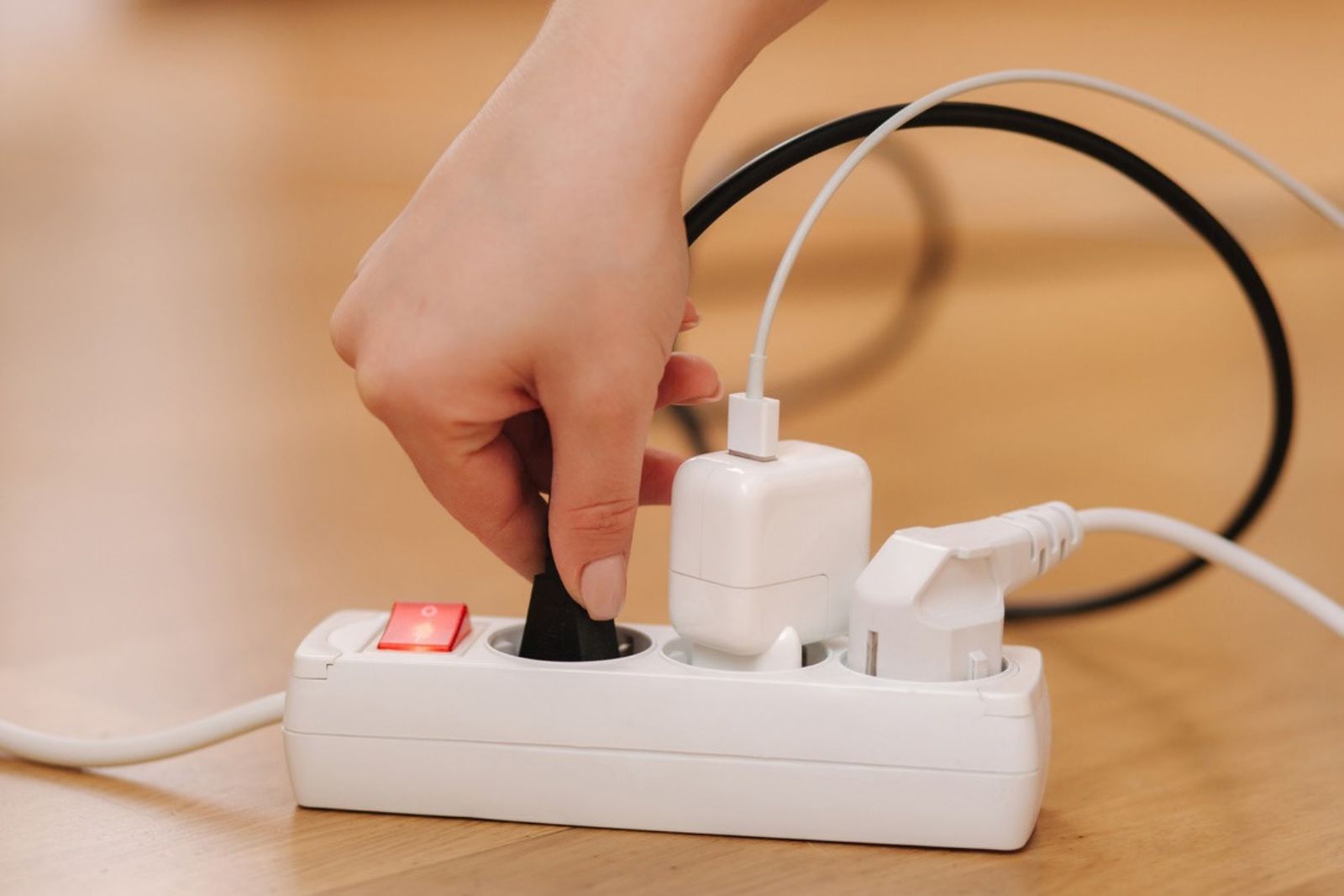
- Space heaters, the deadliest of the list: 1,500 watts drawn continuously for hours turns a strip’s thin internal contacts into a hotplate inside a plastic shell. Safety authorities single heaters out explicitly: wall outlet only, no exceptions, including “heavy-duty” strips.
- Microwaves, toasters, toaster ovens, coffee makers, air fryers: each pulls 800 to 1,800 watts in bursts; a typical strip tops out around 1,875 watts total, so one appliance can consume the entire budget alone. It’s the same logic behind the firefighters’ unplug-it-at-night rule.
- Refrigerators and freezers: their compressors cycle on with a surge, all day, every day, wearing the strip’s contacts and risking the one failure a fridge can’t forgive, a dead outlet discovered a day later.
- Washers, dryers, dishwashers, portable AC units: heat plus motor plus water nearby. Wall, always.
- Hair dryers, irons, curling tools: enormous draw in short spikes, usually in a bathroom, the worst room for improvised wiring.
- Another power strip. Daisy-chaining is the overload mistake in its purest form: each added junction stacks resistance and multiplies connections, which is why it’s both a classic fire scenario and a code violation.
The 60-second test of a safe setup
Audit each strip with four checks. One: walk the never-list; anything with a heating element or compressor moves to a wall outlet today. Two: do the arithmetic once: add the wattages on the labels of what’s plugged in (phone chargers 5-20 W, laptop 60-100 W, TV 100-200 W, lamp 10-60 W) and keep the total comfortably under the strip’s rating, which is printed on its underside, typically 1,800-1,875 W. Three: touch it after an evening’s use; a strip that feels warm, smells faintly of plastic, has a scorched outlet or flickers when something switches on is telling you it’s failing: replace it. Four: check the pedigree: a UL or ETL mark, a built-in circuit breaker, and no strip older than a few years of heavy service; the $4 bargain strip is where the 3,300 fires live.
What strips are actually for
Everything else, which is to say the low, steady loads: TVs, consoles, modems, routers, lamps, chargers, speakers. That’s the job they’re built for, and a surge-protected strip genuinely earns its keep there by shielding electronics. For the full story on the four worst offenders, an electrician walked us through them here.
Heat, motor, or four digits of wattage: the wall. Everything quiet and steady: the strip, added up once and checked with a hand. Sixty seconds per strip, and the most common electrical mistake in the house is gone. That’s the rule.