

If you bought a house in the US between 1990 and 2010, you probably know this exact shade of orange-honey oak. Builders used it in millions of homes. It filled subdivisions across the Sun Belt, the Midwest, and almost every mid-market suburb in between. Real estate agents now call it the “orange tax” on resale.
That’s where this laundry room starts.
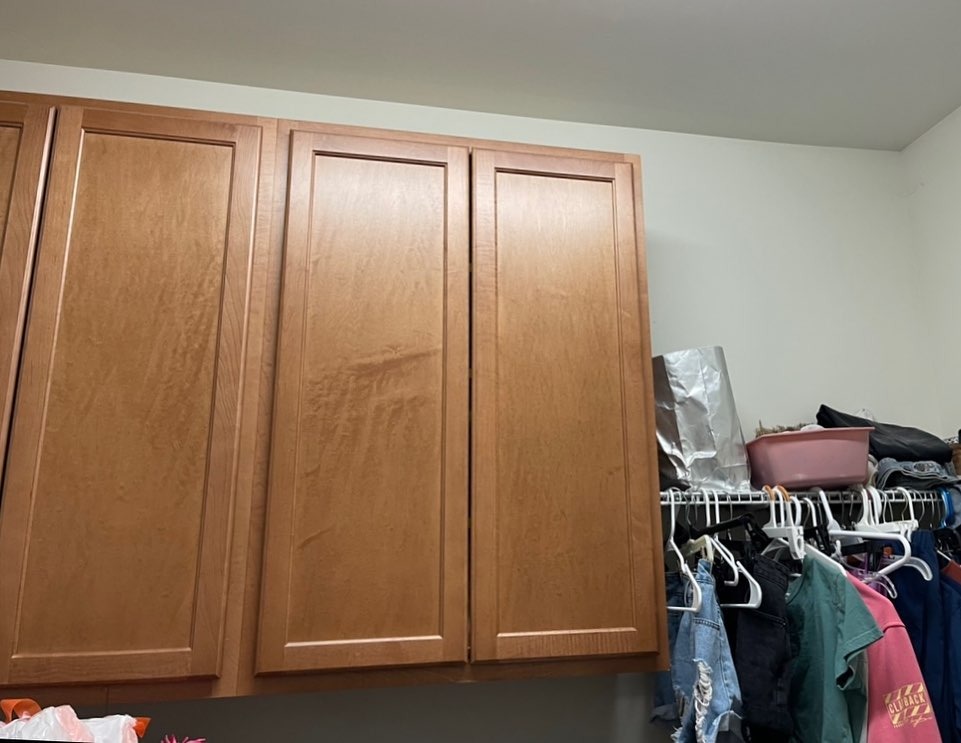
The oak nobody wants to touch
The homeowner called in My Renewed Cabinets, a female-owned refinishing team on Instagram as @myrenewedcabinets, and asked them to handle it. Not rip it out. Just handle it.
Honey oak is the most-hated finish in American housing for a reason. The orange undertone fights every modern paint color. Soft whites turn pink next to it. Greiges go green. Even the warm-minimalist trends that rescued other oak finishes quietly left this specific shade behind.
Why most people just close the door
New cabinets cost real money. A small Shaker set from a big-box store runs around $4,000 (about €3,700) installed. Custom climbs fast into five figures. For a laundry room, which almost nobody wants to spend serious money on, those numbers kill the project before it starts. So the door stays closed, the finish stays orange, and the room drops out of the home-improvement conversation entirely.
She didn’t take that route.
She didn’t rip a single cabinet out
The whole transformation runs on one idea: leave the boxes, change the surface.
Every cabinet stayed on the wall. Every door and hinge stayed in place. The red washer and dryer stayed. The tight footprint stayed. The utility sink stayed exactly where it was plumbed. Only what you can see on the surface actually changed.
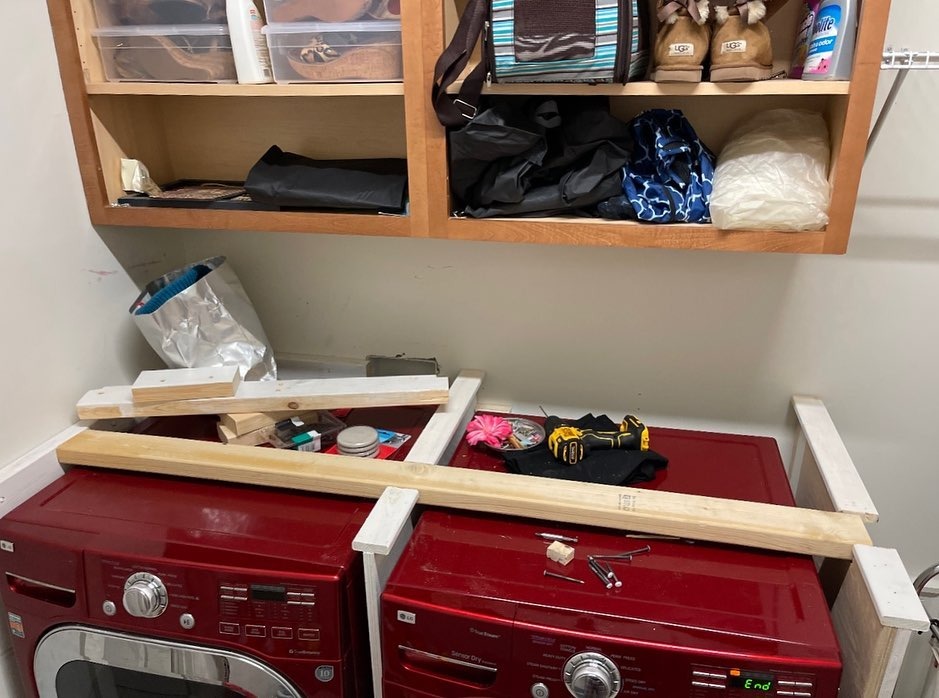
The in-progress photo catches the exact moment it’s happening. Oak boxes still on the wall. Appliances still bare. Fresh pine ledgers getting clamped across the washer and dryer to carry a new counter. A drill, a few screws, scattered hardware. Nothing demolished, nothing hauled out to the curb.
The Renner coating does the real work
Most people who paint cabinets at home reach for a $40 (about €37) can of latex and a brush. The result looks fine for about a year. Then it chips at every hinge and pull, and the orange starts bleeding through the first time a steam iron kisses the door.
She skipped that path. My Renewed Cabinets uses Renner, an Italian wood-coating line that pros spray through HVLP guns. It cures harder than any consumer paint, shrugs off water and detergent splash, and survives years of being banged shut. That’s the single reason the After photos still look like a factory finish instead of a weekend repaint.
Quartz on top, peel tile behind
Two upgrades do most of the visual lifting.
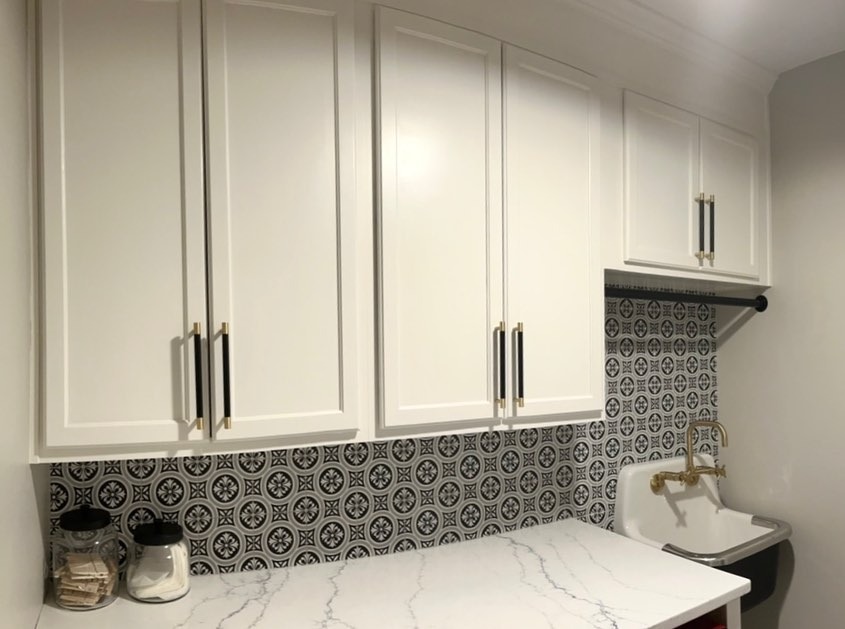
First, a white veined quartz slab was laid straight across the tops of the washer and dryer. One move, and the appliances turn into a working counter instead of a dead stop. Second, a black and white cement-tile peel-and-stick backsplash runs behind the sink and up the back wall. The pattern alone reads like a $40-per-square-foot (about €37) Moroccan install for a tiny fraction of the cost.
Long black-and-brass pulls finish the cabinet doors. They’re the most modern thing in the room and they read as European, not farmhouse. A brass wall-mount bridge faucet now sits over the original utility sink, which never came off the wall.
Even the red appliances stayed in
Here’s the quiet second lesson. Almost every makeover account would have begged her to swap the red LG washer and dryer for white or stainless. She left them. The black-and-white cement tile pulls so much visual weight that the red ends up reading as a punchy color accent instead of a mismatch.
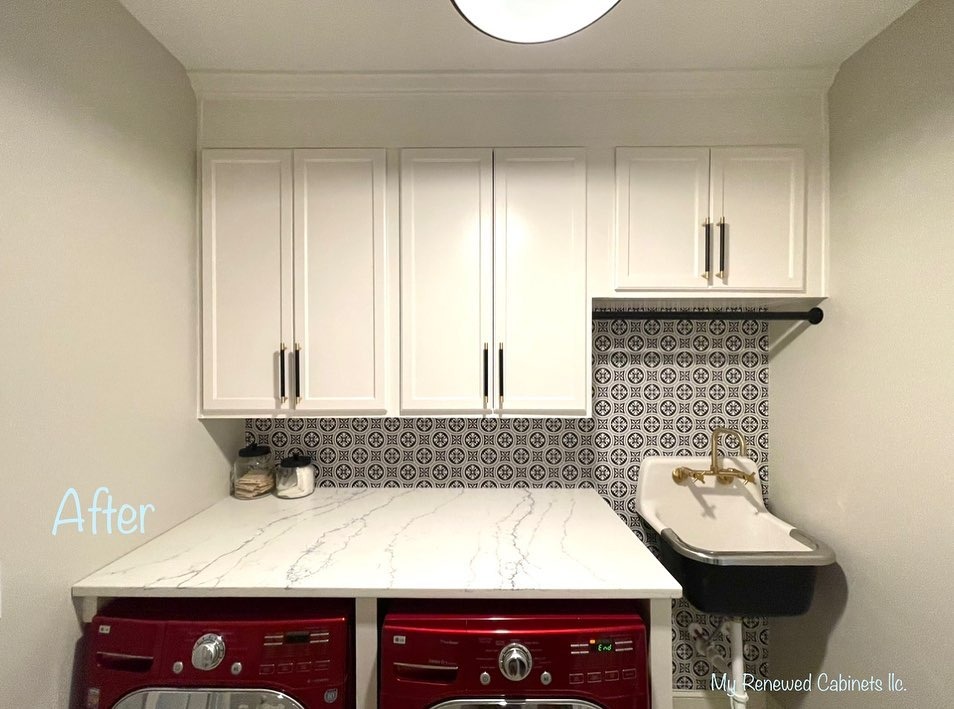
If you have an inherited fridge, a bisque washer-dryer set, or any single oddly colored appliance stuck in a room you want to update, that lesson alone is worth more than any paint chip.
For anyone sitting on honey oak and a $12,000 (about €11,200) replacement quote, the final frame is the whole argument. The boxes stayed. The appliances stayed. Only the surface changed. And the room now looks like it belongs in a boutique hotel instead of a 1998 build.




How does this look like it belongs in a boutique hotel? It’s pretty boring. If it wasn’t for the red appliances, it would be a yawn fest