
You’ve seen a hundred kitchen makeovers where the first move is tearing out the speckled 2000s granite. The usual line: no paint can save a counter that busy, so rip it out and start over.
The couple behind this kitchen ignored all of that. Granite, floors, appliances, even the honey oak cabinet boxes all stayed in place. Two cans of paint later, the finished room honestly looks like somebody else’s house.
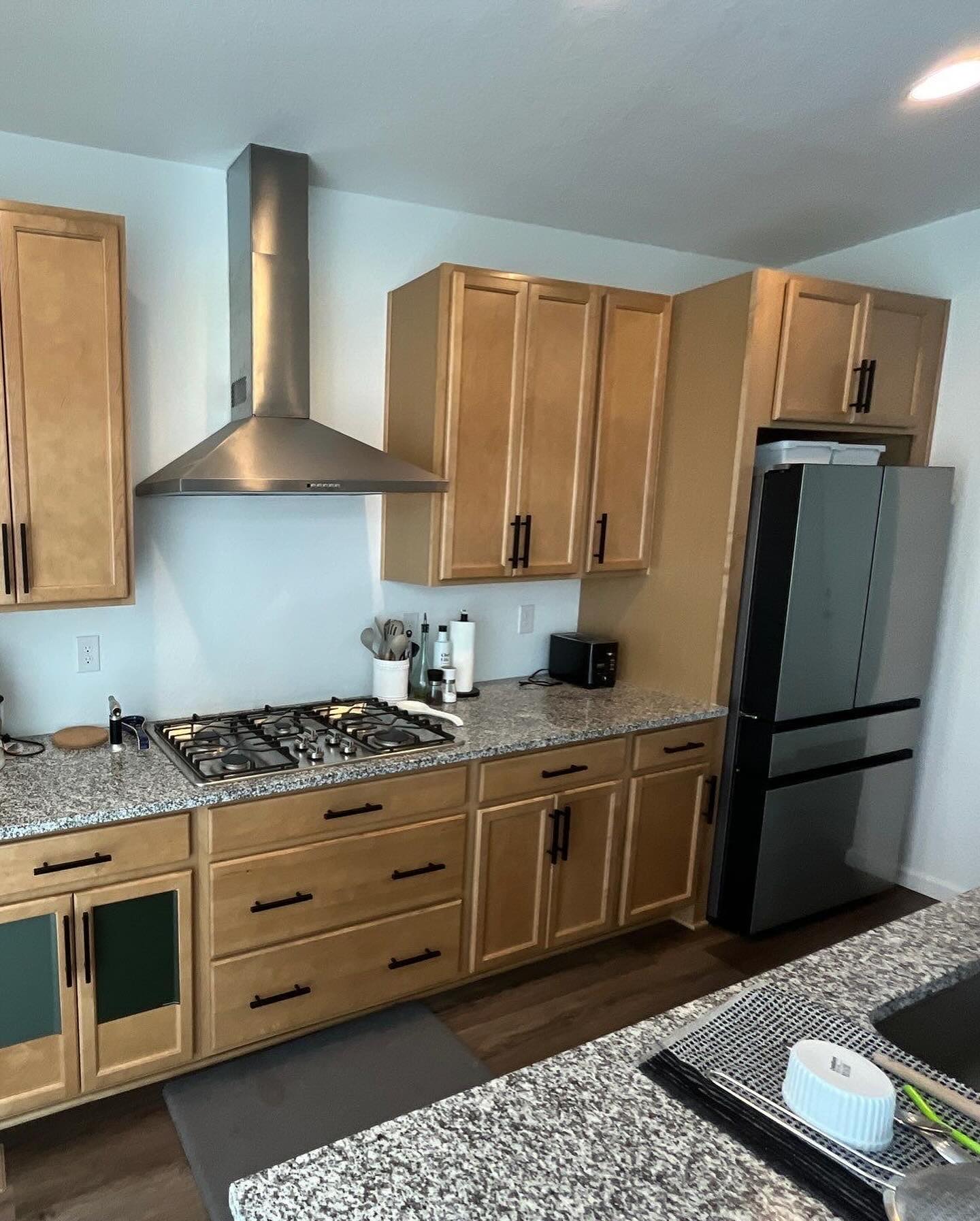
The starting point was a builder-grade kitchen you’ll find in a few million American homes: honey oak doors with that familiar warm orange cast, granite counters packed with cream and gray and black flecks, a stainless chimney hood over a five-burner gas cooktop, and dark vinyl plank floors. Functional, clean, and completely forgettable.
Why she didn’t call the countertop company first
A quote to replace the granite and cabinets would have landed north of eighteen thousand dollars (around €16,700), closer to twenty-five with new backsplash and hardware. Plus six weeks of plywood subfloors, construction dust, and takeout.
Instead she sat with the kitchen for a minute and asked what was really dragging it down. Not the stone or the layout. The color. The honey-orange oak was fighting the cream in the granite, and nothing was pulling the two together. Paint is cheap, reversible, and never involves a plumber, so paint won the argument.
Ripe Olive on the bottom, Stone Hearth on top
Two colors carry the whole makeover.
The lower cabinets are Sherwin-Williams Ripe Olive (SW 6209), a saturated and slightly moody green with warm undertones hiding inside it. It isn’t forest green, sage, or olive-oil yellow. It’s earthy and grounded, the way a good trench coat is earthy and grounded.
The uppers are Benjamin Moore Stone Hearth (984), a soft cream with a warm beige cast that reads as “considered” instead of “boring.” That’s more than you can say for either stark white or builder beige in this kind of room.
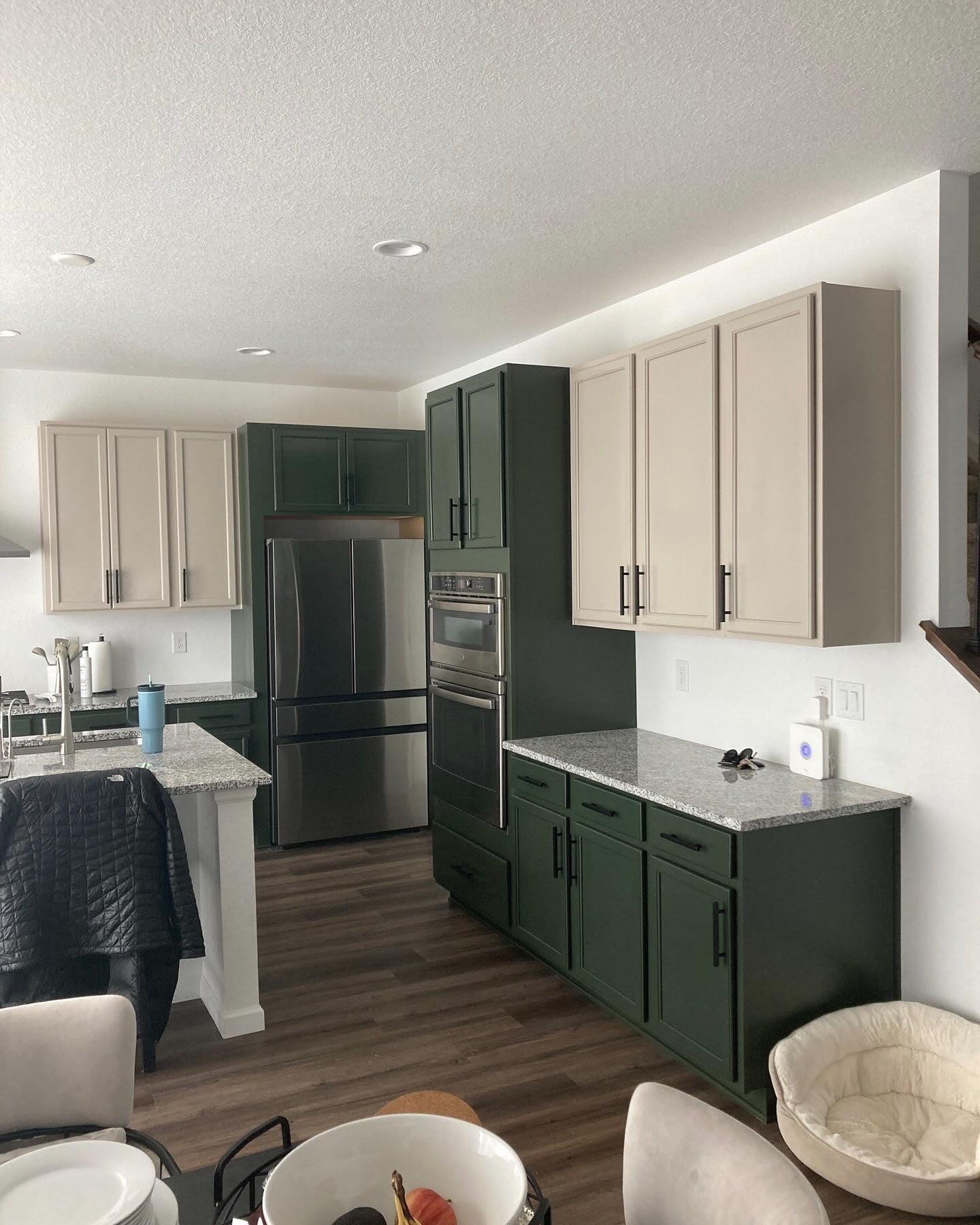
What finally makes speckled granite work
Look closely at the counter. There are only three colors in that stone: a cream base, cool gray streaks, and black speckles. The old oak picked up none of them, which is why the orange in the wood kept fighting the cream in the stone.
Ripe Olive does something smarter. It doesn’t try to match the granite; it gives the warm cream tones something confident to live next to. Stone Hearth does the same thing from above, quietly echoing the lightest flecks. The counter suddenly looks chosen, instead of inherited from whoever owned the house in 2008.
Why the matte black hardware does more than you’d think
Easy to miss, but worth stopping on. The old round brushed-nickel knobs got swapped for long matte black bar pulls, and those pulls aren’t just a 2024 trend chasing Pinterest. They’re echoing the black speckles already sitting in the granite, which sews the whole palette together. Pull any one of the three (green, cream, or black pulls) out of the mix and the balance falls apart.
The prep work nobody loves but everybody needs
This is where most DIY cabinet jobs go sideways: the finish peels within six months because nobody wanted to spend a Saturday prepping.
She did the opposite. Every door and drawer came off, hinges got bagged and labeled, and the cabinet boxes were wiped down with degreaser, lightly sanded to break the factory finish, then hit with a bonding primer. Everything else in the kitchen, including the hood and the surrounding wall, was masked off with painter’s tape, brown kraft paper, and plastic sheeting.
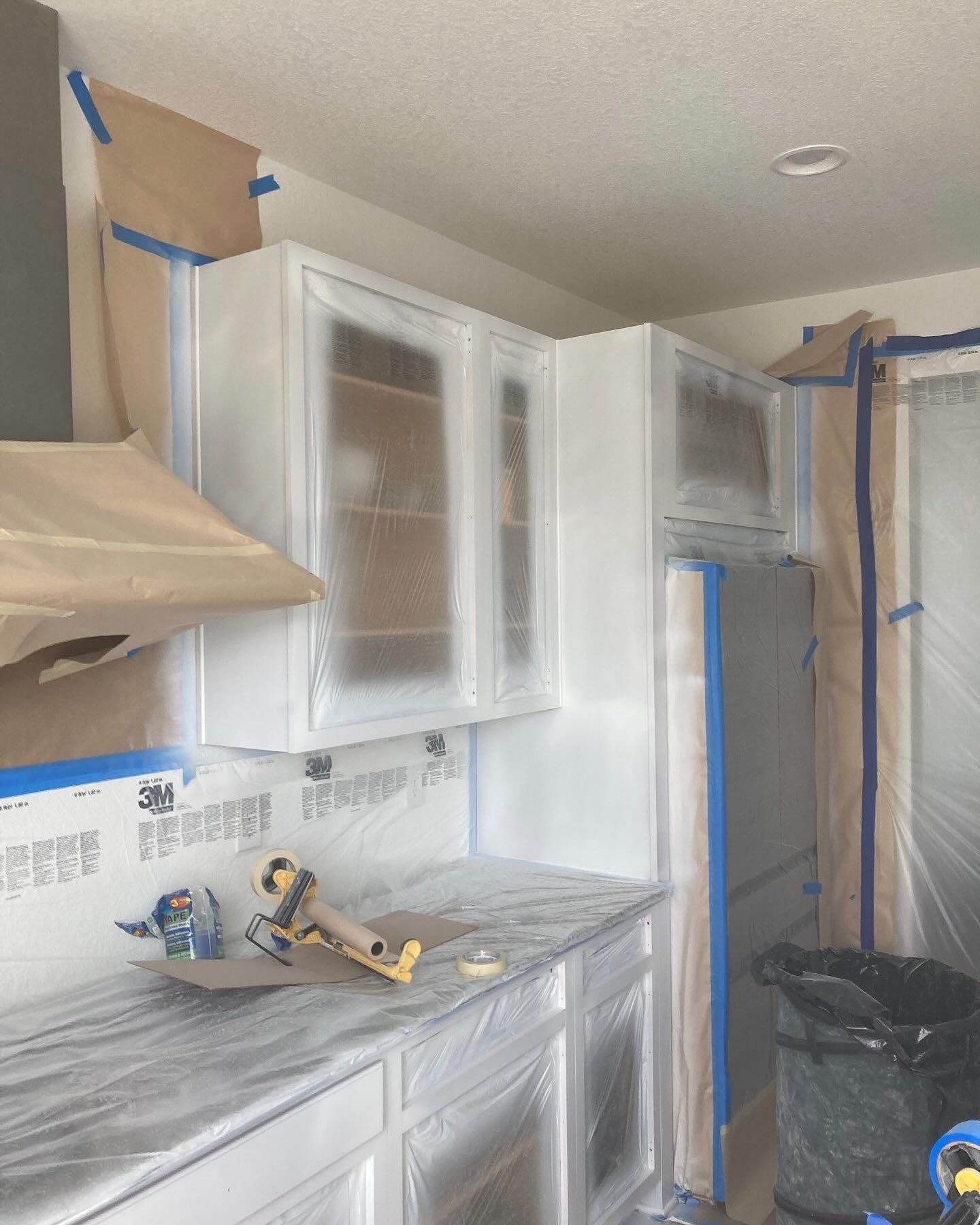
Why the primer and masking matter so much
Primer is what actually makes cabinet paint stick to slick factory-finished wood; skip it and your finish chips around the knobs within a season. The masking is what keeps the kitchen from looking like somebody got loose with a roller near the hood. Both steps are boring and both are non-negotiable.
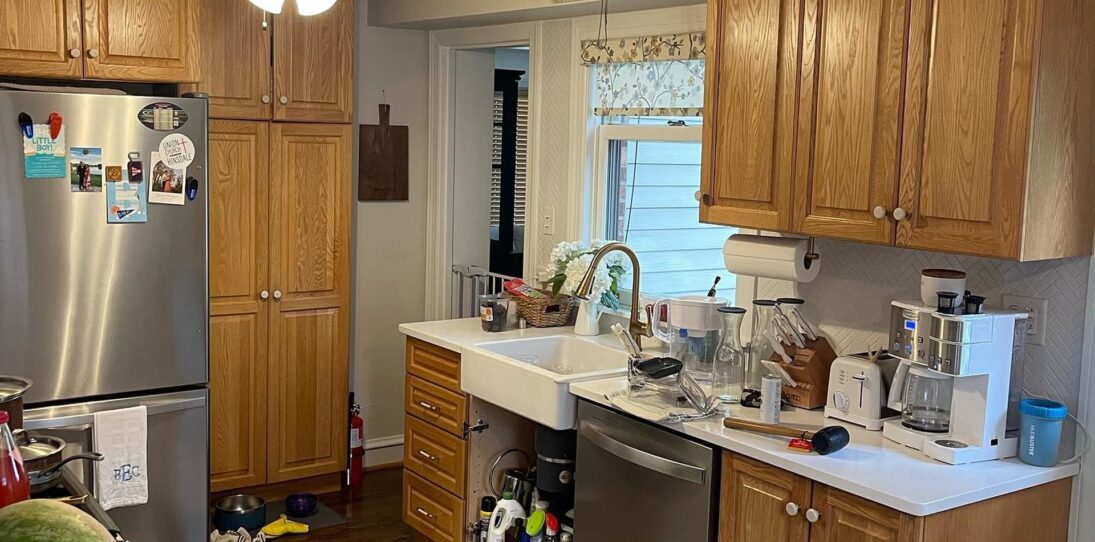
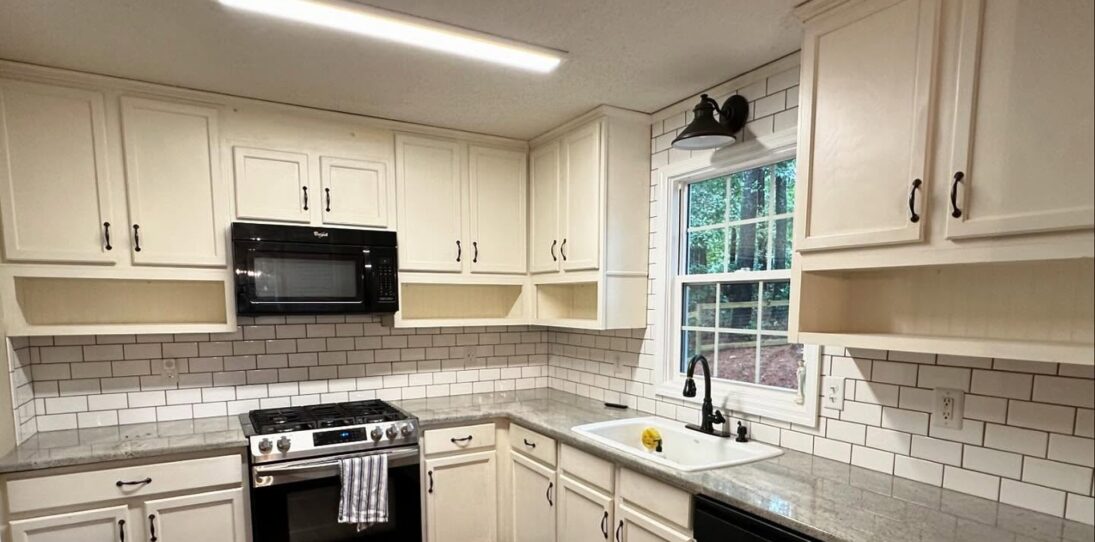
Same corner, different kitchen entirely
Two coats of Ripe Olive on the lowers and two coats of Stone Hearth up top. Granite, hood, cooktop, and all five burners are still exactly where they were.
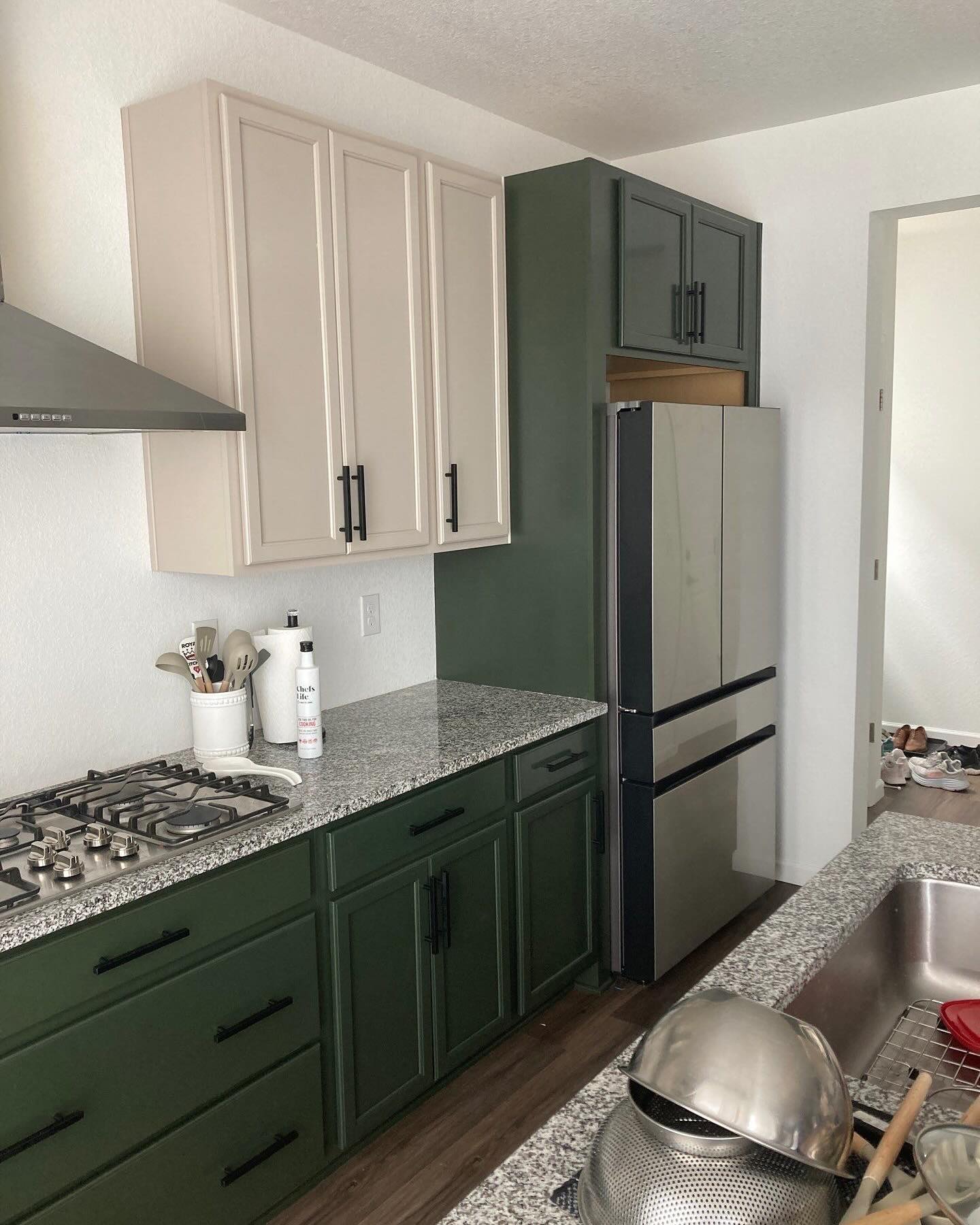
The ceiling feels higher, the stainless appliances suddenly look deliberate instead of lonely, and the stone that read as dated a day earlier now looks like a design choice somebody actually made on purpose.
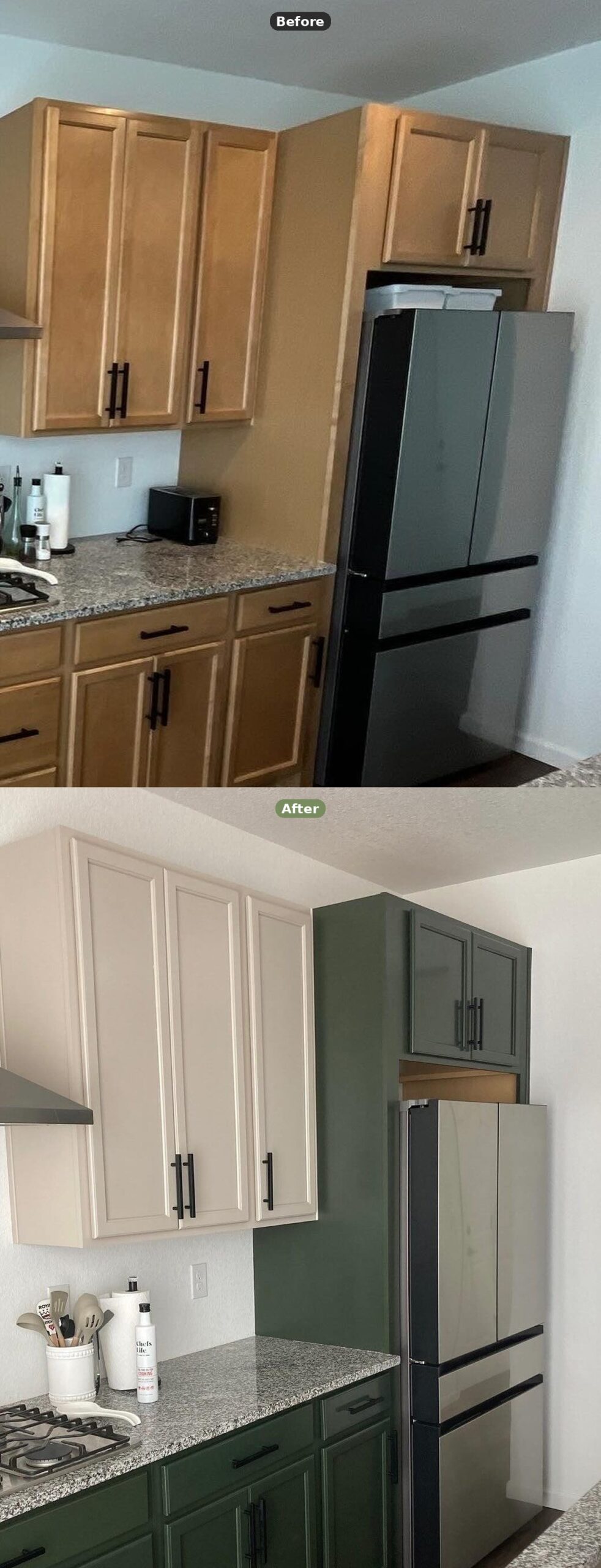
Fridge wall, before and after
Here’s the fridge wall with the paint doing the heavy lifting on its own.
What this whole thing cost, roughly
Two gallons of good cabinet paint at about $70 (around €65) each, a gallon of bonding primer, plus all the tape, paper, and plastic supplies come to roughly $200 (around €185). New matte black bar pulls run $2 to $4 (around €2 to €4) each on Amazon. All in, you’re looking at $400 to $500 (around €370 to €460) and one long weekend of work. Set that next to a $20,000 renovation quote and the math isn’t close.
The playbook if you have this same kitchen
If you’re staring at honey or golden oak and speckled granite you can’t afford to replace, you have more options than the internet gives you credit for. The trick isn’t finding a paint color that hides your counter. It’s finding one that finally has a conversation with it.
Ripe Olive and Stone Hearth is one combo that lands, but it’s not the only one. Warm mushroom with soft cream, dusty navy with oatmeal, or smoky charcoal with bone white can all pull off the same move. The rule is the same: pick two cabinet colors that share undertones with the warm parts of your granite, swap the hardware to echo the darkest flecks, and skip the demolition quote. A weekend of work and roughly four hundred dollars, for the kitchen you thought needed twenty grand.