

You know your Siamese cat’s evening routine: a stop at the windowsill, a visit to the sofa, and a pointed look when dinner runs late. When that routine changes, you may find yourself watching the little things more closely. A suddenly ignored windowsill can feel just as puzzling as a cat who won’t leave your side.
In short
- Stress can bring out repetitive behaviors in Siamese cats, including fabric sucking and excessive grooming.
- Early weaning and a home without places to climb or hide are linked to these behaviors.
- Play gives an active Siamese cat an outlet and time to bond with you.
- Siamese cats account for roughly 50% to 65% of cats affected by the compulsive disorders described by the Center for Canine Behavior Studies.
Stress shows up in familiar places
View in gallery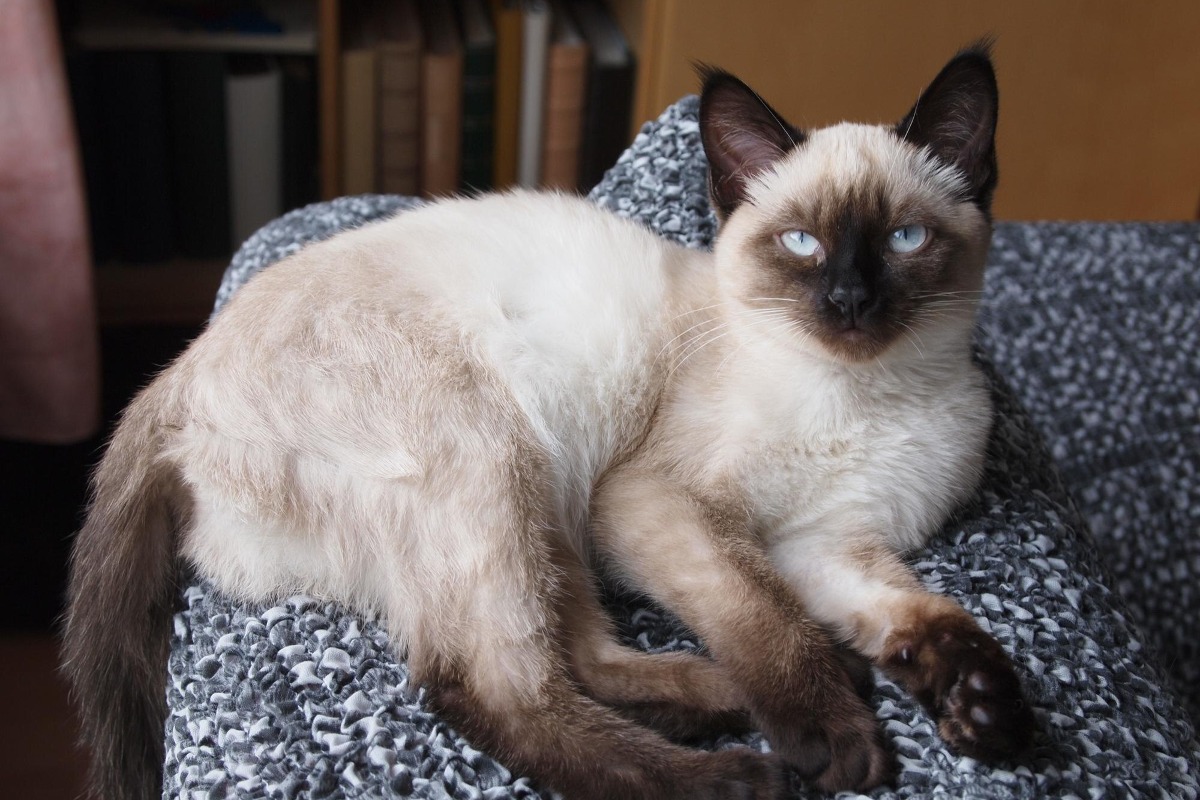
You find your Siamese cat curled beside a sweater, its mouth working at the sleeve. Later, you notice it licking the same patch of fur again and again. As veterinarian Carlos Gutiérrez explains, “they tend to develop obsessive behaviors if they get stressed.”
For Siamese cats, that can look like sucking or chewing fabric, repeated grooming, or chasing the tail over and over. Fabric sucking, often called wool sucking, is especially associated with Siamese and other oriental breeds. It might be a blanket or a sweater. Either way, it’s the repetition you’ll notice.
Gutiérrez describes Siamese cats as active, exploratory animals. When you see one returning to the same behavior, it helps to look beyond the sweater or the patch of fur. Broaden your view and take a look at what is going on around them, too.
Early experiences and home life matter
A cat’s early life can shape what you see later. A study of 5,726 household cats found a link between early weaning and repetitive behavior. The researchers also found a link with aggression. Their sample included Siamese and Birman cats among 40 breeds.
Breed matters as well. The Merck Veterinary Manual describes fabric chewing in Siamese and similar cats as probably hereditary. So if your Siamese seems fixated on your jumper sleeve, it may simply be in their genes
Then there is the space your cat lives in now. Siamese cats generally enjoy high places and spots where they can tuck themselves away, even a cardboard box. A home without those options can add to their stress.
Play gives that energy somewhere to go
Picture your cat following a toy across the living room, then climbing up to survey the room from a shelf. Those are opportunities to move and explore. High places, hiding spots and play give an active Siamese cat more to do than return to a sweater.
Gutiérrez singles out play as a useful way for these cats to release tension. It also gives you time together. You don’t have to turn your home upside down to see what your cat enjoys: a place to climb, a box to investigate and a toy you use together all fit the needs he describes.
Every cat is different, and it is important to watch and learn what your cat likes to do, for that gives you the baseline to watch for unusual behavior. You might spot the behaviour on the sweater, but the real need, for more activity, sits elsewhere in the room. Giving your Siamese places to explore and time to play addresses that need.
The limit
Not every Siamese cat develops compulsive behavior, and fabric chewing may also reflect inherited tendencies. Repeated licking isn’t proof of stress: Gutiérrez says itching, pain or other physical discomfort can cause it, too. If your cat keeps licking excessively or chewing fabric, talk with your veterinarian to rule out anything medical.